by The Open University
Available in 42 free installments
Owner:
The last time I presented was to a group of students as a tutor. I had to explain a complex layout used inside a mobile phone. In order to help the students understand, I decided to use visual aids: in this case a simple overhead projection with a three- dimensional picture and a sub-component of the phone. By sharing the ?exploded? view picture of the phone with all the sub-components laid out, I was able to help the students see where and how the pieces of the phone fitted together. Then, by handing around an antenna sub-assembly, I could show them how small and precise some of the fittings for the phone were. Most of us were very surprised at how interesting the components were, and it helped make the point that in many cases we are blasé about the amount of complex technology all around us.
Many of us are diffident about expressing our ideas and feelings. We can feel nervous or embarrassed when speaking in public or working through an idea in front of an audience. Here are some typical reactions we found when we asked other students to respond to Activity 2:
I know exactly the point I want to make, but by the time I get the opportunity to express myself ? all that comes out is a confused babble.
I have a very definite regional accent and need to make a special effort in order to be understood. I am OK just chatting but when I get on my feet in class I can hear my voice in my head, just mumbling away.
English is not my first language and I lose confidence when I have to stand up in front of others in my group ? it is easier with strangers.
I find it difficult to organise my thoughts when speaking to a group or even just to my supervisor ? I feel I must read from my notes directly.
If you have ever felt like this, then you are certainly not alone ? I think it is safe to say that we all feel some degree of nervousness in giving a presentation. But this is natural, and without having at least a little bit of anxiety you may find yourself too relaxed. Keep in mind though that a little tension is helpful because it will bring about an adrenaline rush that will get you onto your feet and ready to give your presentation.
One of the oldest (and probably one of the best!) descriptions of what a speaker should do during a presentation is attributed to an army commander who said that to ensure an effective presentation you simply need to:
Tell them what you are going to tell them.
Tell them.
Tell them what you just told them.
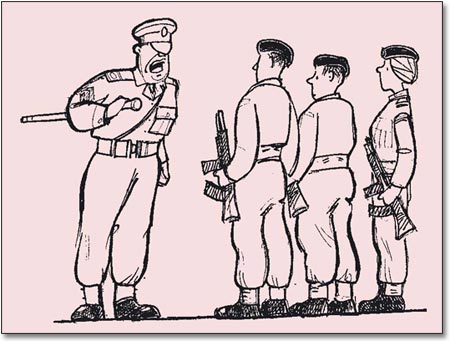 Long description
A rather more colloquial piece of advice also often given advises you to:
Stand up.
Speak up.
Shut up.
A bit blunt in the approach and language, but you might find that for certain audiences this simple A, B, C formula works well. The three steps can be thought of as the beginning (A), middle (B) and end (C) of a story. So, as with storytelling, you need to open up the context of the talk in the A section, then present the bulk of your findings in the B section, and within C re-cap on what you have said and reiterate certain key points.
Presentation-giving skills can be learnt and continually improved through practice. Some tension is necessary in order to produce the adrenaline rush that initially gets you up on your feet and ready to deliver the work that you have put so much effort into.
