by Wikibooks, open books for an open world
Available in 123 free installments
Owner:
The transmission of FBN is a complex phenomenon. Over the past few decades, considerable amount of research had gone into mathematical modeling of pressure and flow transient in the circuit. This involves the solution of wave equations, with piping treated as a distributed parameter system known as a transmission line [1] & [3].
Lets consider a simple pump-pipe-loading valve circuit as shown in Fig. 2. The pressure and flow ripple at any location in the pipe can be described by the relations:
 .........(1)
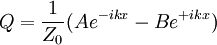 .....(2)
where  and
and  are frequency dependent complex coefficients which are directly proportional to pump (source) flow ripple, but also functions of the source impedance
  , characteristic impedance of the pipe
  and the termination impedance
  . These impedances ,usually vary as the system operating pressure and flow rate changes, can be determined experimentally.
For complex systems with several system components, the pressure and flow ripples are estimated using the transformation matrix approach. For this, the system components can be treated as lumped impedances (a throttle valve or accumulator), or distributed impedances (flexible hose or silencer). Various software packages are available today to predict the pressure pulsations.
The transmission of SBN follows the classic source-path-noise model. The vibrations of the swash plate, the main cause of SBN, are transferred to the pump casing which encloses all the rotating group in the pump including displacement chambers (also known as cylinder block), pistons, and the swash plate. The pump case, apart from vibrating itself, transfers the vibration down to the mount on which the pump is mounted. The mount then passes the vibrations down to the main mounted structure or the vehicle. Thus the SBN is transferred from the swash plate to the main structure or vehicle via pumpcasing and mount.
Some of the machine structures, along the path of transmission, are good at transmitting this vibrational energy and they even resonate and reinforce it. By converting only a fraction of 1% of the pump structureborne noise into sound, a member in the transmission path could radiate more ABN than the pump itself [4].
