by Wikibooks, open books for an open world
Available in 123 free installments
Owner:
This theory comes from the homogeneous Helmoltz equation  . Considering a simple geometry of a parallelepiped (L1,L2,L3), the solution of this problem is with separated variables :
Hence each function X, Y and Z has this form :
X(x) = Ae ? ikx + BeikxWith the boundary condition  , for x=0 and x=L1 (idem in the other directions), the expression of pressure is :


where m,n,p are whole numbers
It is a three-dimensional stationary wave. Acoustic modes appear with their modal frequencies and their modal forms. With a non-homogeneous problem, a problem with an acoustic source Q in r0, the final pressure in r is the sum of the contribution of all the modes described above.
The modal density  is the number of modal frequencies contained in a range of 1Hz. It depends on the frequency f, the volume of the room V and the speed of sound c0 :
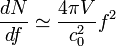
The modal density depends on the square frequency, so it increase rapidly with the frequency. At a certain level of frequency, the modes are not distinguished and the modal theory is no longer relevant.
