by Wikibooks, open books for an open world
Available in 123 free installments
Owner:
This theory uses the hypothesis of the diffuse field, the acoustical field is homogeneous and isotropic. In order to obtain this field, the room has to be enough reverberating and the frequencies have to be high enough to avoid the effects of predominating modes.
The variation of the acoustical energy E in the room can be written as :
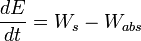
Where Ws and Wabs are respectively the power generated by the acoustical source and the power absorbed by the walls.
The power absorbed is related to the voluminal energy in the room e :

Where a is the equivalent absorption area defined by the sum of the product of the absorption coefficient and the area of each material in the room :

The final equation is : 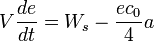
The level of stationary energy is : 
With this theory described, the reverberation time can be defined. It is the time for the level of energy to decrease of 60 dB. It depends on the volume of the room V and the equivalent absorption area a :
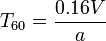 Sabine formula
This reverberation time is the fundamental parameter in room acoustics and depends trough the equivalent absorption area and the absorption coefficients on the frequency. It is used for several measurement :

Due to the famous principle enounced by Gustav Theodor Fechner, the sensation of perception doesn?t follow a linear law, but a logarithmic one. The perception of the intensity of light, or the sensation of weight, follow this law, as well. This observation legitimates the use of logarithmic scales in the field of acoustics. A 80dB (10-4 W/m²) sound seems to be twice as loud as a 70 dB (10-5 W/m²) sound, although there is a factor 10 between the two acoustic powers. This is quite a naïve law, but it led to a new way of thinking acoustics, by trying to describe the auditive sensations. That?s the aim of psychoacoustics. By now, as the neurophysiologic mechanisms of human hearing haven?t been successfully modelled, the only way of dealing with psychoacoustics is by finding metrics that best describe the different aspects of sound.
