by Wikibooks, open books for an open world
Available in 123 free installments
Owner:
Even for the free space propagation of an acoustic wave created by a punctual source it is difficult to reduce noise in a large area, using active noise control, as we will see in the section.
In the case of an acoustic wave created by a monopolar source, the Helmholtz equation becomes:
?p + k2p = ? j??0qwhere q is the flow of the noise sources.
The solution for this equation at any M point is:
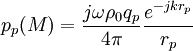
where the p mark refers to the primary source.
Let us introduce a secondary source in order to perform active control of noise. The acoustic pressure at that same M point is now:

It is now obvious that if we chose 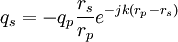 there is no more noise at the M point. This is the most simple example of active control of noise. But it is also obvious that if the pressure is zero in M, there is no reason why it should also be zero at any other N point. This solution only allows to reduce noise in one very small area.
However, it is possible to reduce noise in a larger area far from the source, as we will see in this section. In fact the expression for acoustic pressure far from the primary source can be approximated by:

 Control of a monopole by another monopole
As shown in the previous section we can adjust the secondary source in order to get no noise in M. In that case, the acoustic pressure in any other N point of the space remains low if the primary and secondary sources are close enough. More precisely, it is possible to have a pressure close to zero in the whole space if the M point is equally distant from the two sources and if: D < ? / 6 where D is the distance between the primary and secondary sources. As we will see later on, it is easier to perform active control of noise with more than on source controlling the primary source, but it is of course much more expensive.
A commonly admitted estimation of the number of secondary sources which are necessary to reduce noise in an R radius sphere, at a frequency f is:
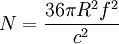
This means that if you want no noise in a one meter diameter sphere at a frequency below 340Hz, you will need 30 secondary sources. This is the reason why active control of noise works better at low frequencies.
This section requires from the reader to know the basis of modal propagation theory, which will not be explained in this article.
For an infinite and straight duct with a constant section, the pressure in areas without sources can be written as an infinite sum of propagation modes:

where ? are the eigen functions of the Helmoltz equation and a represent the amplitudes of the modes.
The eigen functions can either be obtained analytically, for some specific shapes of the duct, or numerically. By putting pressure sensors in the duct and using the previous equation, we get a relation between the pressure matrix P (pressure for the various frequencies) and the A matrix of the amplitudes of the modes. Furthermore, for linear sources, there is a relation between the A matrix and the U matrix of the signal sent to the secondary sources: As = KU and hence: A = Ap + As = Ap + KU.
Our purpose is to get: A=0, which means: Ap + KU = 0. This is possible every time the rank of the K matrix is bigger than the number of the propagation modes in the duct.
Thus, it is theoretically possible to have no noise in the duct in a very large area not too close from the primary sources if the there are more secondary sources than propagation modes in the duct. Therefore, it is obvious that active noise control is more appropriate for low frequencies. In fact the more the frequency is low, the less propagation modes there will be in the duct. Experiences show that it is in fact possible to reduce the noise from over 60dB.
The principle is rather similar to the one described above, except the resonance phenomenon has a major influence on acoustic pressure in the cavity. In fact, every mode that is not resonant in the considered frequency range can be neglected. In a cavity or enclosure, the number of these modes rise very quickly as frequency rises, so once again, low frequencies are more appropriate. Above a critical frequency, the acoustic field can be considered as diffuse. In that case, active control of noise is still possible, but it is theoretically much more complicated to set up.
As we have seen, it is possible to reduce noise with a finite number of secondary sources. Unfortunately, the perception of sound of our ears does not only depend on the acoustic pressure (or the decibels). In fact, it sometimes happen that even though the number of decibels has been reduced, the perception that we have is not really better than without active control.
