by Wikibooks, open books for an open world
Available in 123 free installments
Owner:
 Figure 1: Schematics
The most simple way of simulating the motion of vocal folds is to use a single mass-spring-damper system as shown above. The mass represents one vocal fold, and the second vocal fold is assumed to be symmetry about the axis of symmetry. Position 3 represents a location immediately past the exit (end of the mass), and position 2 represents the glottis (the region between the two vocal folds).
The major driving force behind the oscillation of vocal folds is the pressure in the glottis. The Bernoulli's equation from fluid mechanics states that:
 -----EQN 1
Neglecting potential difference and applying EQN 1 to positions 2 and 3 of Figure 1,
 -----EQN 2
Note that the pressure and the velocity at position 3 cannot change. This makes the right hand side of EQN 2 constant. Observation of EQN 2 reveals that in order to have oscillating pressure at 2, we must have oscillation velocity at 2. The flow velocity inside the glottis can be studied through the theories of the orifice flow.
The constriction of airflow at the vocal folds is much like an orifice flow with one major difference: with vocal folds, the orifice profile is continuously changing. The orifice profile for the vocal folds can open or close, as well as change the shape of the opening. In Figure 1, the profile is converging, but in another stage of oscillation it takes a diverging shape.
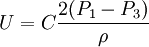
The orifice flow is described by Blevins as:
 -----EQN 3
Where the constant C is the orifice coefficient, governed by the shape and the opening size of the orifice. This number is determined experimentally, and it changes throughout the different stages of oscillation.
Solving equations 2 and 3, the pressure force throughout the glottal region can be determined.
As the video of the vocal folds shows, vocal folds can completely close during oscillation. When this happens, the Bernoulli equation fails. Instead, the collision force becomes the dominating force. For this analysis, Hertz collision model was applied.
FH = kHdelta3 / 2(1 + bHdelta') -----EQN 4
where
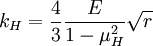
Here delta is the penetration distance of the vocal fold past the line of symmetry.
