by Wikibooks, open books for an open world
Available in 123 free installments
Owner:
On a typical loudspeaker, the cone serves the purpose of creating a larger radiating area allowing more air to be moved when excited by the voice coil. The cone serves a piston that is excited by the voice coil. The cone then displaces air creating a sound wave. In an ideal environment, the cone should be infinitely rigid and have zero mass, but in reality neither is true. Cone materials vary from carbon fiber, paper, bamboo, and just about any other material that can be shaped into a stiff conical shape. The loudspeaker cone is a very critical part of the loudspeaker. Since the cone is not infinitely rigid, it tends to have different types of resonance modes form at different frequencies, which in turn alters and colors the reproduction of the sound waves. The shape of the cone directly influences the directivity and frequency response of the loudspeaker. When the cone is attached to the voice coil, a large gap above the voice coil is left exposed. This could be a problem if foreign particles make their way into the air gap of the voice coil and the permanent magnet structure. The solution to this problem is to place what is known as a dust cap on the cone to cover the air gap. Below a figure of the cone and dust cap are shown.
 Figure 6 Cone and Dust Cap attached to Voice Coil
The speed of the cone can be expressed with an equation of a mass-spring system with a damping coefficient \xi :

The current intensity i and the speed v can also be related by this equation (U is the voltage, R the electrical resistance and Lb the inductance) :
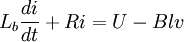
By using a harmonic solution, the expression of the speed is :
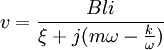
The electrical impedance can be determined as the ratio of the voltage on the current intensity :

The frequency response of the loudspeaker can be ploted.
 Figure 7 Electrical impedance
A phenomena of electrical resonance is observable around the frequency of 100 Hz. Besides, the inductance of the coil makes the impedance increase from the frequency of 400 Hz. So the range of frequency where the loudspeaker is used is 100 - 4000 Hz
