by Wikibooks, open books for an open world
Available in 104 free installments
Owner:
On the basis of the above you should be able to appreciate that there is a relationship between the Decay Constant and the Half Life. For example when the Decay Constant is small the Half Life should be long and correspondingly when the Decay Constant is large the Half Life should be short. But what exactly is the nature of this relationship?
We can easily answer this question by using the definition of Half Life and applying it to the Radioactive Decay Law.
Once again the law tells us that at any time, t:

and the definition of Half Life tells us that:

when

We can therefore re-write the Radioactive Decay Law by substituting for Nt and t as follows:
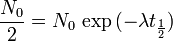
Therefore
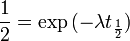

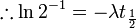
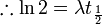
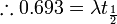

and

These last two equations express the relationship between the Decay Constant and the Half Life. They are very useful as you will see when solving numerical questions relating to radioactivity and usually form the first step in solving a numerical problem.
