by Wikibooks, open books for an open world
Available in 104 free installments
Owner:
Three questions are given below to help you develop your understanding of the material presented in this chapter. The first one is relatively straight-forward and will exercise your application of the Radioactive Decay Law as well as your understanding of the concept of Half Life. The second question is a lot more challenging and will help you relate the Radioactive Decay Law to the number of radioactive nuclei which are decaying in a sample of radioactive material. The third question will help you understand the approach used in the second question by asking a similar question from a slightly different perspective.
Question 1
(a) The half-life of 99mTc is 6 hours. After how much time will 1/16th of the radioisotope remain?
(b) Verify your answer by another means.
Answer:
(a) Starting with the relationship we established earlier between the Decay Constant and the Half Life we can calculate the Decay Constant as follows:

Now applying the Radioactive Decay Law,

we can re-write it in the form:
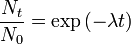
The question tells us that N0 has reduced to 1/16th of its value, that is:

Therefore
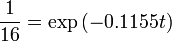
which we need to solve for t. One way of doing this is as follows:


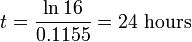
So it will take 24 hours until 1/16th of the radioactivity remains.
(b) A way in which this answer can be verified is by using the definition of Half Life. We are told that the Half Life of 99mTc is 6 hours. Therefore after six hours half of the radioactivity remains.
Therefore after 12 hours a quarter remains; after 18 hours an eighth remains and after 24 hours one sixteenth remains. And we arrive at the same answer as in part (a). So we must be right!
Note that this second approach is useful if we are dealing with relatively simple situations where the radioactivity is halved, quartered and so on. But supposing the question asked how long would it take for the radioactivity to decrease to a tenth of its initial value. Deduction from the definition of half life is rather more difficult in this case and the mathematical approach used for part (a) above will yield the answer more readily.
Question 2
Find the radioactivity of a 1 g sample of 226Ra given that t1/2: 1620 years and Avogadro's Number: 6.023 x 10²³.
Answer:
We can start the answer like we did with Question 1(a) by calculating the Decay Constant from the Half Life using the following equation:


Note that the length of a year used in converting from 'per year' to 'per second' above is 365.25 days to account for leap years. In addition the reason for converting to units of 'per second' is because the unit of radioactivity is expressed as the number of nuclei decaying per second.
Secondly we can calculate that 1 g of 226Ra contains:

Thirdly we need to express the Radioactive Decay Law in terms of the number of nuclei decaying per unit time. We can do this by differentiating the equation as follows:


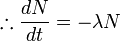
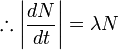
The reason for expressing the result above in absolute terms is to remove the minus sign in that we already know that the number is decreasing.
We can now enter the data we derived above for ? and N:


So the radioactivity of our 1 g sample of radium-226 is approximately 1 Ci.
This is not a surprising answer since the definition of the curie was originally conceived as the radioactivity of 1 g of radium-226!
Question 3
What is the minimum mass of 99mTc that can have a radioactivity of 1 MBq? Assume the half-life is 6 hours and that Avogadro's Number is 6.023 x 10²³.
Answer
Starting again with the relationship between the Decay Constant and the Half Life:

Secondly the question tells us that the radioactivity is 1 MBq. Therefore since 1 MBq = 1 x 10⁶ decays per second,
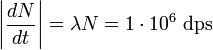

Finally the mass of these nuclei can be calculated as follows:


In other words a mass of just over five picograms of 99mTc can emit one million gamma-rays per second. The result reinforces an important point that you will learn about radiation protection which is that you should treat radioactive materials just like you would handle pathogenic bacteria!
