DC Voltage Dependence
If we were to build a detector and electronic circuit as shown in the figure above we could conduct an experiment that would allow us to explore the effect of the dc voltage on the magnitude of the voltage pulses produced across the resistor, R. Note that the term pulse height is frequently used in this field to refer to the magnitude of voltage pulses.
Ideally, we could generate a result similar to that illustrated in the following figure:
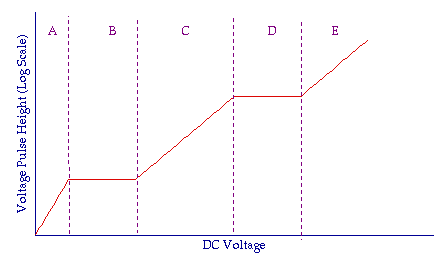
The graph illustrates the dependence of the pulse height on the dc voltage. Note that the vertical axis representing the pulse height is on a logarithmic scale for the sake of compressing a large linear scale onto a reasonably-sized graph.
The experimental results can be divided into five regions as shown. We will now consider each region in turn.
- Region A Here Vdc is relatively low so that recombination of positive ions and electrons occurs. As a result not all ion pairs are collected and the voltage pulse height is relatively low. It does increase as the dc voltage increases however as the amount of recombination reduces.
- Region B Vdc is sufficiently high in this region so that only a negligible amount of recombination occurs. This is the region where a type of detector called the Ionization Chamber operates.
- Region C Vdc is sufficiently high in this region so that electrons approaching the centre wire attain sufficient energy between collisions with the electrons of gas atoms to produce new ion pairs. Thus the number of electrons is increased so that the electric charge passing through the resistor, R, may be up to a thousand times greater than the charge produced initially by the radiation interaction. This is the region where a type of detector called the Proportional Counter operates.
- Region D Vdc is so high that even a minimally-ionizing particle will produce a very large voltage pulse. The initial ionization produced by the radiation triggers a complete gas breakdown as an avalanche of electrons heads towards and spreads along the centre wire. This region is called the Geiger-Müller Region, and is exploited in the Geiger Counter.
- Region E Here Vdc is high enough for the gas to completely breakdown and it cannot be used to detect radiation.
We will now consider features of the Ionisation Chamber and the Geiger Counter in more detail.

