by Various
Available in 585 free installments
Owner:
Farr has drawn diagrams of bending moment for forty different very heavy locomotives on different spans, and has determined for each case a uniform load which at every point would produce as great a bending moment as the actual wheel loads. The following short abstract gives the equivalent uniform load which produces bending moments as great as those of any of the engines calculated:?
|
Span in Ft. |
Load per ft. run equivalent to actual Wheel Loads in Tons, for each Track. |
|
5.0 |
7.6 |
|
10.0 |
4.85 |
|
20.0 |
3.20 |
|
30.0 |
2.63 |
|
50.0 |
2.24 |
|
100.0 |
1.97 |
Fig. 36 gives the loads per axle and the distribution of loads in some exceptionally heavy modern British locomotives.
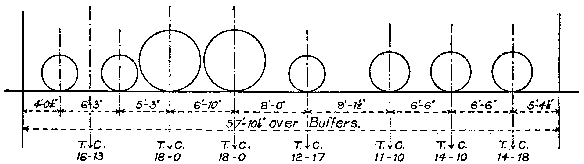 Express Passenger Engine, G.N. Ry.
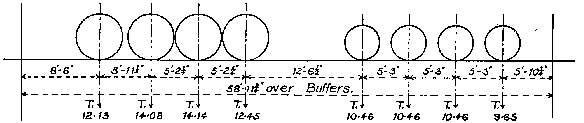 Goods Engine, L. & Y. Ry.
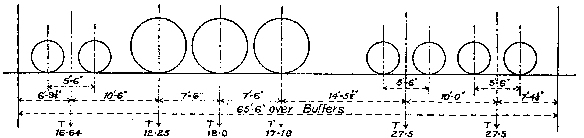 Passenger Engine, Cal. Ry.
In Austria the official regulations require that railway bridges shall be designed for at least the following live loads per foot run and per track:?
|
Span. |
Live Load in Tons. |
||
|
Metres. |
Ft. |
Per metre run. |
Per ft. run. |
|
1 |
3.3 |
20 |
6.1 |
|
2 |
6.6 |
15 |
4.6 |
|
5 |
16.4 |
10 |
3.1 |
|
20 |
65.6 |
5 |
1.5 |
|
30 |
98.4 |
4 |
1.2 |
It would be simpler and more convenient in designing short bridges if, instead of assuming an equivalent uniform rolling load, agreement could be come to as to a typical heavy locomotive which would produce stresses as great as any existing locomotive on each class of railway. Bridges would then be designed for these selected loads, and the process would be safer in dealing with flooring girders and shearing forces than the assumption of a uniform load.
