by Various
Available in 585 free installments
Owner:
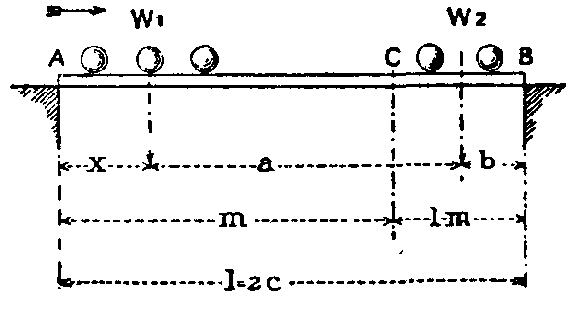 Fig. 48.
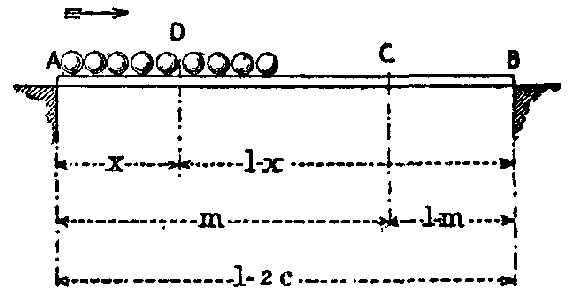 Fig. 47.
26. Greatest Bending Moment due to travelling concentrated Loads.?For the greatest bending moment due to a travelling live load, let a load of w per ft. run advance from the left abutment (fig. 47), and let its centre be at x from the left abutment. The reaction at B is 2wx²/l and the bending moment at any section C, at m from the left abutment, is 2wx²/(l-m)/l, which increases as x increases till the span is covered. Hence, for uniform travelling loads, the bending moments are greatest when the loading is complete. In that case the loads on either side of C are proportional to m and l-m. In the case of a series of travelling loads at fixed distances apart passing over the girder from the left, let W1, W2 (fig. 48), at distances x and x+a from the left abutment, be their resultants on either side of C. Then the reaction at B is W1x/l+W2(x+a)/l. The bending moment at C is
M = W1x(l-m)/l+W2m{1-(x+a)/l}.
If the loads are moved a distance ?x to the right, the bending moment becomes
M+?M = W1(x+?x)(l-m)/l+W2m{1-(x+?x+a)/l}
?m = W1?x(l-m)/l-W2?xm/l,
and this is positive or the bending moment increases, if W1(l-m) > W2m, or if W1/m > W2/(l-m). But these are the average loads per ft. run to the left and right of C. Hence, if the average load to the left of a section is greater than that to the right, the bending moment at the section will be increased by moving the loads to the right, and vice versa. Hence the maximum bending moment at C for a series of travelling loads will occur when the average load is the same on either side of C. If one of the loads is at C, spread over a very small distance in the neighbourhood of C, then a very small displacement of the loads will permit the fulfilment of the condition. Hence the criterion for the position of the loads which makes the moment at C greatest is this: one load must be at C, and the other loads must be distributed, so that the average loads per ft. on either side of C (the load at C being neglected) are nearly equal. If the loads are very unequal in magnitude or distance this condition may be satisfied for more than one position of the loads, but it is not difficult to ascertain which position gives the maximum moment. Generally one of the largest of the loads must be at C with as many others to right and left as is consistent with that condition.
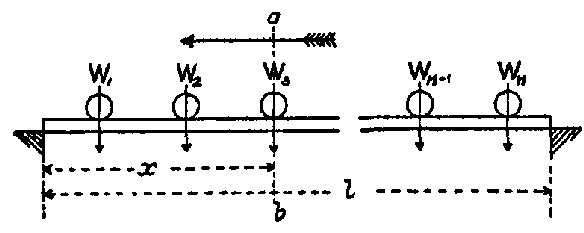 Fig. 49.
This criterion may be stated in another way. The greatest bending moment will occur with one of the greatest loads at the section, and when this further condition is satisfied. Let fig. 49 represent a beam with the series of loads travelling from the right. Let a b be the section considered, and let Wx be the load at a b when the bending moment there is greatest, and Wn the last load to the right then on the bridge. Then the position of the loads must be that which satisfies the condition
x l |
greater than | W1+W2+... Wx-1 W1+W2+... Wn |
| x |
