by Various
Available in 585 free installments
Owner:
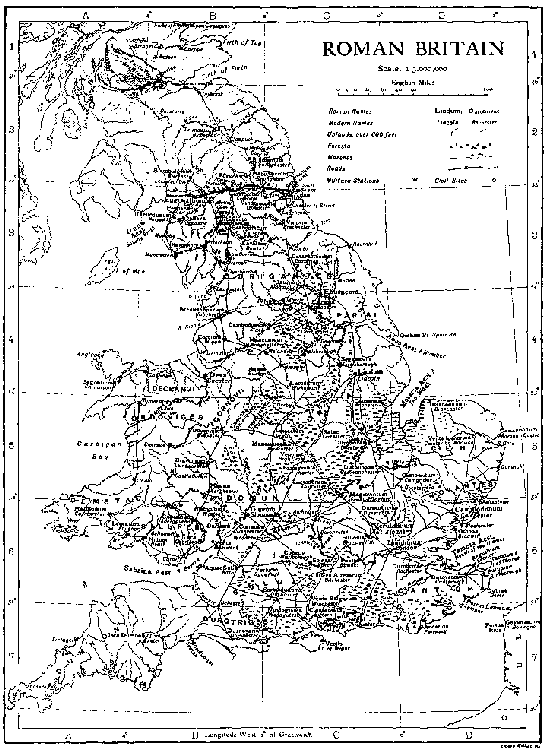
A more difficult task remained. The wild hills and wilder tribes of Wales and Yorkshire offered far fiercer resistance. There followed thirty years of intermittent hill fighting (A.D. 47-79). The precise steps of the conquest are not known. Legionary fortresses were established at Wroxeter (for a time only), Chester and Caerleon, facing the Welsh hills, and at Lincoln in the northeast. Monmouthshire, and Flintshire with its lead mines, were early overrun; in 60 Suetonius Paulinus reached Anglesea. The method of conquest was the establishment of small detached forts in strategic positions, each garrisoned by 500 or 1000 men, and it was accompanied by a full share of those disasters which vigorous barbarians always inflict on civilized invaders. Progress was delayed too by the great revolt of Boadicea (q.v.) and a large part of the nominally conquered Lowlands. Her rising was soon crushed, but the government was obviously afraid for a while to move its garrisons forward. Indeed, other needs of the empire caused the withdrawal of the Fourteenth Legion about 67. But the decade A.D. 70-80 was decisive. A series of three able generals commanded an army restored to its proper strength by the addition of Legio II. Adiutrix, and achieved the final subjugation of Wales and the first conquest of Yorkshire, where a legionary fortress at York was substituted for that at Lincoln.
The third and best-known, if not the ablest, of these generals, Julius Agricola, moved on in A.D. 80 to the conquest of the farther north. He established between the Clyde and Forth a frontier meant to be permanent, guarded by a line of forts, two of which are still traceable at Camelon near Falkirk, and at Bar Hill. He then advanced into Caledonia and won a "famous victory" at Mons Graupius (sometimes, but incorrectly, spelt Grampius), probably near the confluence of the Tay and the Isla, where a Roman encampment of his date, Inchtuthill, has been partly examined (see Galgacus). He dreamt even of invading Ireland, and thought it an easy task. The home government judged otherwise. Jealous possibly of a too brilliant general, certainly averse from costly and fruitless campaigns and needing the Legio II. Adiutrix for work elsewhere, it recalled both governor and legion, and gave up the more northerly of his nominal conquests. The most solid result of his campaigns is that his battlefield, misspelt Grampius, has provided to antiquaries, and through them to the world, the modern name of the Grampian Hills.
What frontier was adopted after Agricola's departure, whether Tweed or Cheviot or other, is unknown. For thirty years (A.D. 85-115) the military history of Britain is a blank. When we recover knowledge we are in an altered world. About 115 or 120 the northern Britons rose in revolt and destroyed the Ninth Legion, posted at York, which would bear the brunt of any northern trouble. In 122 the second reigning emperor who crossed the ocean, Hadrian, came himself to Britain, brought the Sixth Legion to replace the Ninth, and introduced the frontier policy of his age. For over 70 m. from Tyne to Solway, more exactly from Wallsend to Bowness, he built a continuous rampart, more probably of turf than of stone, with a ditch in front of it, a number of small forts along it, one or two outposts a few miles to the north of it, and some detached forts (the best-known is on the hill above Maryport) guarding the Cumberland coast beyond its western end. The details of his work are imperfectly known, for though many remains survive, it is hard to separate those of Hadrian's date from others that are later. But that Hadrian built a wall here is proved alike by literature and by inscriptions. The meaning of the scheme is equally certain. It was to be, as it were, a Chinese wall, marking the definite limit of the Roman world. It was now declared, not by the secret resolutions of cabinets, but by the work of the spade marking the solid earth for ever, that the era of conquest was ended.
But empires move, though rulers bid them stand still. Whether the land beyond Hadrian's wall became temptingly peaceful or remained in vexing disorder, our authorities do not
