by Various
Available in 585 free installments
Owner:
1. Forum.?Near the middle of the town was a rectangular block covering two acres. It comprised a central open court, 132 ft. by 140 ft. in size, surrounded on three sides by a corridor or cloister, with rooms opening on the cloister (fig. 5). On the fourth side was a great hall, with rooms opening into it from behind. This hall was 270 ft. long and 58 ft. wide; two rows of Corinthian columns ran down the middle, and the clerestory roof may have stood 50 ft. above the floor; the walls were frescoed or lined with marble, and for ornament there were probably statues. Finally, a corridor ran round outside the whole block. Here the local authorities had their offices, justice was administered, traders trafficked, citizens and idlers gathered. Though we cannot apportion the rooms to their precise uses, the great hall was plainly the basilica, for meetings and business; the rooms behind it were perhaps law courts, and some of the rooms on the other three sides of the quadrangle may have been shops. Similar municipal buildings existed in most towns of the western Empire, whether they were full municipalities or (as probably Calleva was) of lower rank. The Callevan Forum seems in general simpler than others, but its basilica is remarkably large. Probably the British climate compelled more indoor life than the sunnier south.
2. Temples.?Two small square temples, of a common western-provincial type, were in the east of the town; the cella of the larger measured 42 ft. sq., and was lined with Purbeck marble. A third, circular temple stood between the forum and the south gate. A fourth, a smaller square shrine found in 1907 a little east of the forum, yielded some interesting inscriptions which relate to a gild (collegium) and incidentally confirm the name Calleva.
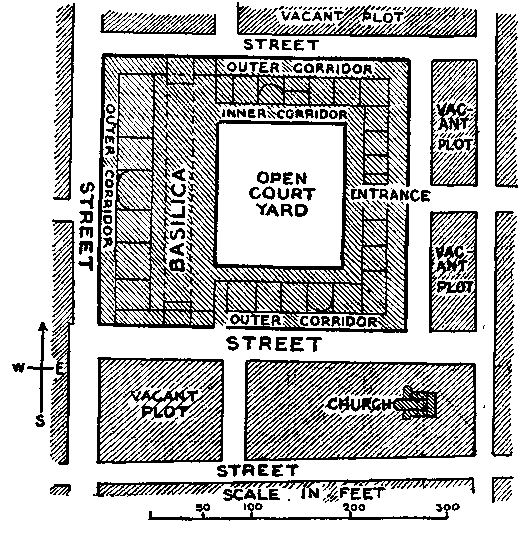 Fig. 5.?Plan of Forum, Basilica and surroundings, Silchester.
3. Christian Church.?Close outside the south-east angle of the forum was a small edifice, 42 ft. by 27 ft., consisting of a nave and two aisles which ended at the east in a porch as wide as the building, and at the west in an apse and two flanking chambers. The nave and porch were floored with plain red tesserae: in the apse was a simple mosaic panel in red, black and white. Round the building was a yard, fenced with wooden palings; in it were a well near the apse, and a small structure of tile with a pit near the east end. No direct proof of date or use was discovered. But the ground plan is that of an early Christian church of the "basilican" type. This type comprised nave and aisles, ending at one end in an apse and two chambers resembling rudimentary transepts, and at the other end in a porch (narthex). Previous to about A.D. 420 the porch was often at the east end and the apse at the west, and the altar, often movable, stood in the apse?as at Silchester, perhaps, on the mosaic panel. A court enclosed the whole; near the porch was a laver for the ablutions of intending worshippers. Many such churches have been found in other countries, especially in Roman Africa; no other satisfactory instance is known in Britain.
4. Town Baths.?A suite of public baths stood a little east of the forum. At the entrance were a peristyle court for loungers and a latrine: hence the bather passed into the Apodyterium (dressing-room), the Frigidarium (cold room) fitted with a cold bath for use at the end of the bathing ceremony, and a series of hot rooms?the whole resembling many modern Turkish baths. In their first form the baths of Silchester were about 160 ft. by 80 ft., but they were later considerably extended.
5. Private Houses.?The private houses of Silchester are of two types. They consist either of a row of rooms, with a corridor along them, and perhaps one or two additional rooms at one or both ends, or of three such corridors and rows of rooms, forming three sides of a large square open yard. They are detached houses, standing each in its own garden, and not forming terraces or rows. The country houses of Roman Britain have long been recognized as embodying these (or allied) types; now it becomes plain that they were the normal types throughout Britain. They differ widely from the town houses of Rome and Pompeii: they are less unlike some of the country houses of Italy and Roman Africa; but their real parallels occur in Gaul, and they may be Celtic types modified to Roman use?like Indian bungalows. Their internal fittings?hypocausts, frescoes,
