by Various
Available in 585 free installments
Owner:
Bricks should not be merely laid, but each should be placed frog upwards, and rubbed and pressed firmly down in such a manner as to secure absolute adhesion, and force the mortar into joints. Every brick should be well wetted before it is laid, especially in hot dry weather, in order to wash off the dust from its surface, and to obtain more complete adhesion, and prevent it from absorbing water from the mortar in which it is bedded. The bricks are wetted either by the bricklayer dipping them in water as he uses them, or by water being thrown or sprinkled on them as they lie piled on the scaffold. In bricklaying with quick-setting cements an ample use of water is of even more importance.
All the walls of a building that are to sustain the same floors and the same roof, should be carried up simultaneously; in no circumstances should more be done in one part than can be reached from the same scaffold, until all the walls are brought up to the same height. Where it is necessary for any reason to leave a portion of the wall at a certain level while carrying up the adjoining work the latter should be racked back, i.e. left in steps as shown in fig. 7, and not carried up vertically with merely the toothing necessary for the bond.
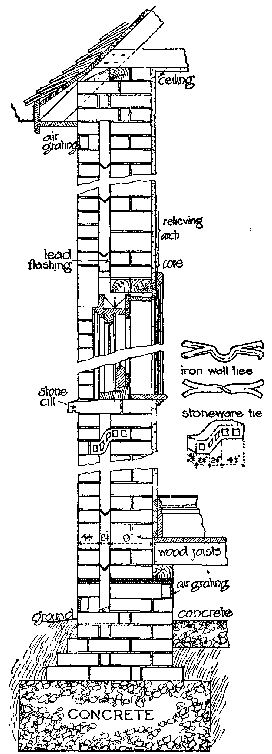 Fig. 2.?Section of a Hollow Wall.
Buildings in exposed situations are frequently built with cavity-walls, consisting of the inside or main walls with an outer skin Hollow walls. usually half a brick thick, separated from the former by a cavity of 2 or 3 in. (fig. 2). The two walls are tied together at frequent intervals by iron or stoneware ties, each having a bend or twist in the centre, which prevents the transmission of water to the inner wall. All water, therefore, which penetrates the outer wall drops to the base of the cavity, and trickles out through gratings provided for the purpose a few inches above the ground level. The base of the cavity should be taken down a course or two below the level of the damp-proof course. The ties are placed about 3 ft. apart horizontally, with 12 or 18 in. vertical intervals; they are about 8 in. long and ¾ in. wide. It is considered preferable by some architects and builders to place the thicker wall on the outside. This course, however, allows the main wall to be attacked by the weather, whereas the former method provides for its protection by a screen of brickwork. Where door and window frames occur in hollow walls, it is of the utmost importance that a proper lead or other flashing be built in, shaped so as to throw off on each side, clear of the frames and main wall, the water which may penetrate the outer shell. While building the wall it is very essential to ensure that the cavity and ties be kept clean and free from rubbish or mortar, and for this purpose a wisp of straw or a narrow board, is laid on the ties where the bricklayer is working, to catch any material that may be inadvertently dropped, this protection being raised as the work proceeds. A hollow wall tends to keep the building dry internally and the temperature equable, but it has the disadvantage of harbouring vermin, unless care be taken to ensure their exclusion. The top of the wall is usually sealed with brickwork to prevent vermin or rubbish finding its way into the cavity. Air gratings should be introduced here to allow of air circulating through the cavity; they also facilitate drying out after rain.
Hollow walls are not much used in London for two reasons, the first being that, owing to the protection from the weather afforded by surrounding buildings, one of the main reasons for their use is gone, and the other that the expense is greatly increased, owing to the authorities ignoring the outer shell and requiring the main wall to be of the full thickness stipulated in schedule I. of London Building Act 1894. Many English provincial authorities in determining the thickness of a cavity-wall, take the outer portion into consideration.
In London and the surrounding counties, brickwork is measured by the rod of 16½ ft. square, 1½ bricks in thickness. A rod of brickwork Materials and labour. gauged four courses to a foot with bricks 8¾ in. long, 4¼ in. wide, and 2¾ in thick, and joints ¼ in. in thickness, will require 4356 bricks, and the number will vary as the bricks are above or below the average size, and as the joints are made thinner or
