by Various
Available in 585 free installments
Owner:
The largest masonry arch is the Adolphe bridge in Luxemburg, erected in 1900-1903. This has a span of 278 ft., 138 ft. rise above the river, and 102 ft. from foundation to crown. The thickness of the arch is 4 ft. 8 in. at the crown and 7 ft. 2 in. where it joins the spandrel masonry. The roadway is 52 ft. 6 in. wide. The bridge is not continuous in width, there are arch rings on each face, each 16.4 ft. wide with a space between of 19.7 ft. This space is filled with a flooring of reinforced concrete, resting on the two arches, and carrying the central roadway. By the method adopted the total masonry has been reduced one-third. One centering was used for the two arch rings, supported on dwarf walls which formed a slipway, along which it was moved after the first was built.
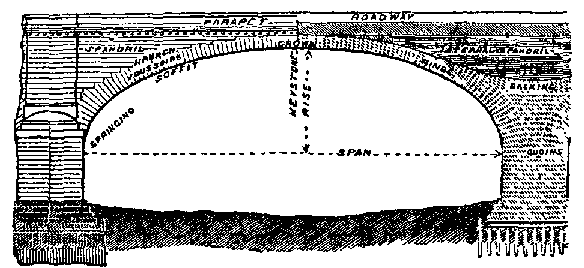 Fig. 9.?Half Elevation and Half Section of Arch of London Bridge.
Till near the end of the 19th century bridges of masonry or brickwork were so constructed that they had to be treated as rigid blockwork structures. The stability of such structures depends on the position of the line of pressure relatively to the intrados and extrados of the arch ring. Generally, so far as could be ascertained, the line of pressure lies within the middle half of the depth of the voussoirs. In finding the abutment reactions some principle such as the principle of least action must be used, and some assumptions of doubtful validity made. But if hinges are introduced at crown and springings, the calculation of the stresses in the arch ring becomes simple, as the line of pressures must pass through the hinges. Such hinges have been used not only for metal arches, but in a modified form for masonry and concrete arches. Three cases therefore arise: (a) The arch is rigid at crown and springings; (b) the arch is two-hinged (hinges at springings); (c) the arch is three-hinged (hinges at crown and springings). For an elementary account of the theory of arches, hinged or not, reference may be made to a paper by H. M. Martin (Proc. Inst. C. E. vol. xciii. p. 462); and for that of the elastic arch, to a paper by A.E.Young (Proc. Inst. C.E. vol. cxxxi. p. 323).
In Germany and America two- and three-hinged arches of masonry and concrete have been built, up to 150 ft. span, with much economy, and the calculations being simple, an engineer can venture to work closely to the dimensions required by theory. For hinges, Leibbrand, of Stuttgart, uses sheets of lead about 1 in. thick extending over the middle third of the depth of the voussoir joints, the rest of the joints being left open. As the lead is plastic this construction is virtually an articulation. If the pressure on the lead is uniformly varying, the centre of pressure must be within the middle third of the width of the lead; that is, it cannot deviate from the centre of the voussoir joint by more than one-eighteenth of its depth. In any case the position of the line of pressures is confined at the lead articulations within very narrow limits, and ambiguity as to the stresses is greatly diminished. The restricted area on which the pressure acts at the lead joints involves greater intensity of stress than has been usual in arched bridges. In the Württemberg hinged arches a limit of stress of 110 tons per sq. ft. was allowed, while in the unhinged arches at Cologne and Coblentz the limit was 50 to 60 tons per sq. ft. (Annales des Fonts et Chaussées, 1891). At Rechtenstein a bridge of two concrete arches has been constructed, span 75½ ft., with lead articulations: width of arch 11 ft.; depth of arch at crown and springing 2.1 and 2.96 ft. respectively. The stresses were calculated to be 15, 17 and 12 tons per sq. ft. at crown, joint of rupture, and springing respectively. At Cincinnati a concrete arch of 70 ft. span has been built, with a rise of 10 ft. The concrete is reinforced by eleven 9-in. steel-rolled joists, spaced 3 ft. apart and supported by a cross-channel joist at each springing. The arch is 15 in. thick at the crown and 4 ft. at the abutments. The concrete consisted of 1 cement, 2 sand and 3 to 4 broken stone. An important series of experiments on the strength of masonry, brick and concrete structures will be found in the Zeitschr. des österreichen Ing. und Arch. Vereines (1895).
