by Various
Available in 585 free installments
Owner:
The Victoria Falls bridge over the Zambezi, designed by Sir Douglas Fox, and completed in 1905, is a combination of girder and arch having a total length of 650 ft. The centre arch is 500 ft. span, the rise of the crown 90 ft., and depth at crown 15 ft. The width between centres of ribs of main arch is 27½ ft. at crown and 53 ft. 9 in at springings. The curve of the main arch is a parabola. The bridge has a roadway of 30 ft. for two lines of rails. Each half arch was supported by cables till joined at the centre. An electric cableway of 900 ft. span capable of carrying 10 tons was used in erection.
12. (g) Movable Bridges can be closed to carry a road or railway or in some cases an aqueduct, but can be opened to give free passage to navigation. They are of several types:?
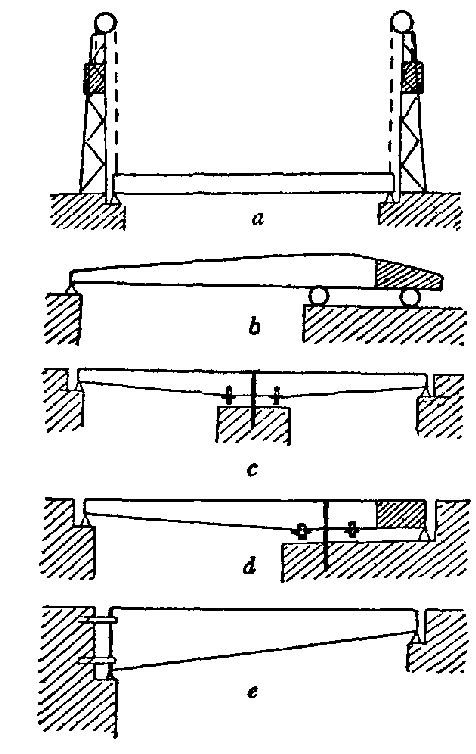 Fig. 33.
(1) Lifting Bridges.?The bridge with its platform is suspended from girders above by chains and counterweights at the four corners (fig. 33 a). It is lifted vertically to the required height when opened. Bridges of this type are not very numerous or important.
(2) Rolling Bridges.?The girders are longer than the span and the part overhanging the abutment is counter-weighted so that the centre of gravity is over the abutment when the bridge is rolled forward (fig. 33 b). To fill the gap in the approaches when the bridge is rolled forward a frame carrying that part of the road is moved into place sideways. At Sunderland, the bridge is first lifted by a hydraulic press so as to clear the roadway behind, and is then rolled back.
(3) Draw or Bascule Bridges.?The fortress draw-bridge is the original type, in which a single leaf, or bascule, turns round a horizontal hinge at one abutment. The bridge when closed is supported on abutments at each end. It is raised by chains and counterweights. A more common type is a bridge with two leaves or bascules, one hinged at each abutment. When closed the bascules are locked at the centre (see fig. 13). In these bridges each bascule is prolonged backwards beyond the hinge so as to balance at the hinge, the prolongation sinking into the piers when the bridge is opened.
(4) Swing or Turning Bridges.?The largest movable bridges revolve about a vertical axis. The bridge is carried on a circular base plate with a central pivot and a circular track for a live ring and conical rollers. A circular revolving platform rests on the pivot and rollers. A toothed arc fixed to the revolving platform or to the live ring serves to give motion to the bridge. The main girders rest on the revolving platform, and the ends of the bridge are circular arcs fitting the fixed roadway. Three arrangements are found: (a) the axis of rotation is on a pier at the centre of the river and the bridge is equal armed (fig. 33 c), so that two navigation passages are opened simultaneously. (b) The axis of rotation is on one abutment, and the bridge is then usually unequal armed (fig. 33 d), the shorter arm being over the land. (c) In some small bridges the shorter arm is vertical and the bridge turns on a kind of vertical crane post at the abutment (fig. 33 e).
(5) Floating Bridges, the roadway being carried on pontoons moored in the stream.
The movable bridge in its closed position must be proportioned like a fixed bridge, but it has also other conditions to fulfil. If it revolves about a vertical axis its centre of gravity must always lie in that axis; if it rolls the centre of gravity must always lie over the abutment. It must have strength to support safely its own overhanging weight when moving.
At Konigsberg there is a road bridge of two fixed spans of 39 ft., and a central span of 60 ft. between bearings, or 41 ft. clear, with balanced bascules over the centre span. Each bascule consists of two main girders with cross girders and stringers. The main girders are hung at each side on a horizontal shaft 8? in. in diameter, and are 6 ft. deep at the hinge, diminishing to 1 ft. 7 in. at the centre of the span. The counterweight is a depressed cantilever arm 12 ft. long, overlapped by the fixed platform which sinks into a recess in the masonry when the bridge opens. In closed position the main girders rest on a bed plate on the face of the pier 4 ft. 3 in. beyond the shaft bearings. The bridge is worked by hydraulic power, an accumulator with a load of 34 tons supplying pressure water at 630 lb per sq. in. The bridge opens in 15 seconds and closes in 25 seconds.
