CN
Such amendments must be passed by the
C/C
Senate and the House of Commons (or, again,
the Commons alone if the Senate delays more
o: ©NC
than 180 days), and by the legislatures of two-
Phot
thirds of the provinces with at least half the
total population of all the provinces (that is,
the total population of Canada excluding the
territories). This means that any four provinces
taken together (for example, the four Atlantic
provinces, or the four Western) could veto
any such amendments. So could Ontario and
Quebec taken together. The seven provinces
needed to pass any amendment would have to
include at least one of the two largest provinces
of Quebec or Ontario.
Any province can, by resolution of its legislature,
opt out of any amendment passed under this
formula that takes away any of its powers, rights
or privileges; and if the amendment it opts
out of transfers power over education or other
In this bronze sculpture on Parliament Hill,
cultural matters to the national Parliament,
Emily Murphy, one of the ?Famous Five? who fought for
Parliament must pay the province ?reasonable
women?s legal status as persons, invites us to celebrate
women?s equality, now enshrined in the Charter.
compensation.?
A Federal State
13
How Canadians Govern Themselves
liamentar
y of Par
o: Libr
Phot
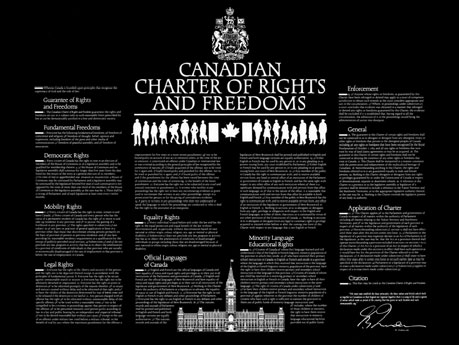
The Charter guarantees four fundamental freedoms and six basic rights.
those covered by the fi rst two formulas). These
nor the composition of the Supreme Court of
amendments can be made by an ordinary act of
Canada, nor the right of a province to at least
the Parliament of Canada.
as many members of the Commons as it had
senators in 1982, nor the amending formulas
The second big change made by the
themselves. On all of these, any single province
Constitution Act, 1982, is that the fi rst three
can impose a veto. Matters coming under the
amending formulas ?entrench? certain parts
second formula can be changed only with the
of the written Constitution: that is, place
consent of seven provinces with at least half the
them beyond the power of Parliament or any
population of the 10.
provincial legislature to touch.
The guarantees for the English and French
For example, the monarchy cannot now be
languages in New Brunswick, Quebec and
touched except with the unanimous consent
Manitoba cannot be changed except with the
of the provinces. Nor can the governor
consent both of the provincial legislatures
generalship, nor the lieutenant-governorships,
concerned and the Senate and House of
14
A Federal State
Commons (or the Commons alone, under
in, any province subject to certain limitations,
the 180-day provision). The guarantees for
notably to provide for ?affi
rmative action?
denominational schools in Newfoundland