enough strength and leeway to meet many of
one people and one government, instead of fi ve
the changed and changing conditions the years
peoples and fi ve governments, with merely a
have brought.
point of authority connecting us to a limited
and insuffi
cient extent.?
The Fathers also, as we have seen, gave a long
list of specifi c examples of exclusive national
powers. They further provided that the
members of the Senate, and all judges from
county courts up (except judges of probate in
Nova Scotia and New Brunswick) should be
appointed by the national government, and that
all lieutenant-governors of the provinces should
be appointed, instructed and removable by the
national government. They gave the national
government and Parliament certain specifi c
powers to protect the educational rights of the
Protestant and Roman Catholic minorities of
the Queen?s subjects. They gave the national
government power to disallow (wipe off the
statute book) any acts of provincial legislatures,
within one year of their passage.
In both the United States and Canada, however,
the precise meaning of the written Constitution
is settled by the courts. In the United States the
courts have, in general, so interpreted their
Constitution as to widen federal and narrow
state powers. In Canada, the courts (notably
the Judicial Committee of the British Privy
Council, which, till 1949, was our highest court)
have in general so interpreted the Constitution
Canadian and American Government
29
How Canadians Govern Themselves
The Rule of Law and
the Courts
eville
andr
anada/Philippe L
ourt of C
eme C
o: Supr
Phot
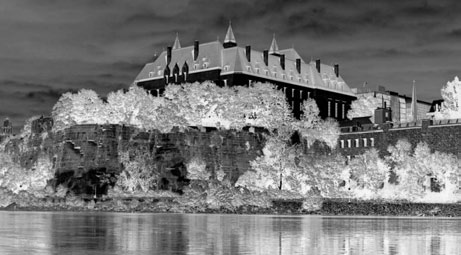
The Supreme Court of Canada Building.
Responsible government and federalism are
bureaucrat; not the armed forces; not
two cornerstones of our system of government.
Parliament itself, or any provincial legislature.
There is a third, without which neither of the
None of these has any powers except those
fi rst two would be safe: the rule of law.
given to it by law: by the Constitution Act,
1867, or its amendments; by a law passed by
What does the rule of law mean?
Parliament or a provincial legislature; or by the
Common Law of England, which we inherited,
and which, though enormously modifi ed by
It means that everyone is subject to the law; that
our own Parliament or provincial legislatures,
no one, no matter how important or powerful,
remains the basis of our constitutional law and
is above the law ? not the government; not
our criminal law, and the civil law (property
the prime minister, or any other minister; not
and civil rights) of the whole country except
the Queen or the Governor General or any
Quebec (which has its own civil code).
lieutenant-governor; not the most powerful
30

