This conclusion is tentative. It must be remembered that the stratification of rubbish-pits, ancient as well as modern, is often very peculiar. It is liable to be confused by all sorts of cross-currents. In particular, objects are constantly thrown into rubbish-pits many years, perhaps even centuries, after those objects have passed out of use. Whenever, even in a village, an old cottage is pulled down or a new one built, old rubbish gets shifted to new places and mixed with rubbish of a quite different age. At Caerwent, as Dr. T. Ashby once told me, a deep rubbish-pit yielded a coin of about A.D. 85 at a third of the way down, and at the very bottom a coin of about 315. That is, the pit was in use about or after 315; some one then shovelled into it debris of much earlier date. The London pits now in question are, however, fairly uniform in their contents, and their evidence may be utilized at least as a base for further inquiries.
(xix-xxii) Rural dwellings. Three Roman 'villas'?that is, country-houses or farms?have been explored in 1914. All are small.
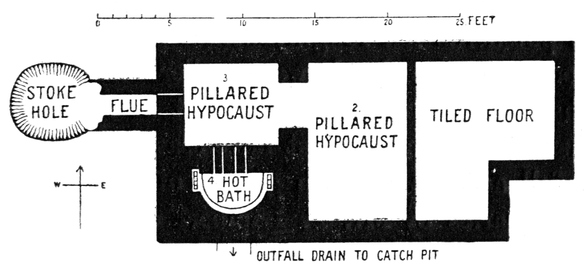
(xix) At East Grimstead, five miles south-east from Salisbury, on Maypole Farm near Churchway Copse5, a bath-house has been dug out and planned by Mr. Heywood Sumner, to whom I owe the following details. The building (fig. 12) measures only 14 × 28 feet and contains only four rooms, (1) a tile-paved apartment which probably served as entrance and dressing-room, (2) a room over a pillared hypocaust, which may be called the tepidarium, (3) a similar smaller room, nearer the furnace and therefore perhaps hotter, which may be the caldarium?though really it is hardly worth while to distinguish between these two rooms?and (4) a semicircular bath, lined with pink mortar and fine cement, warmed with flues from rooms 3 and with box-tiles, and provided with an outfall drain; east of rooms 3 and 4 was the furnace. Small finds included window glass, potsherds, two to three hundred oyster-shells, and five Third Brass coins (two Constantinian, three illegible). Large stone foundations have been detected close by; presumably this was the detached bath-house for a substantial residence which awaits excavation. Such detached bath-houses are common; I may instance one found in 1845 at Wheatley (Oxon.), which had very similar internal arrangements and stood near a substantial dwelling-house not yet explored (Archaeol. Journal, ii. 350). A full description of the Grimstead bath, by Mr. Sumner, is in the press.
(xx) Three miles south-west of Guildford, at Limnerslease in the parish of Compton, Mr. Mill Stephenson has helped to uncover a house measuring 53 × 76 feet, with front and back corridors, and seven rooms, including baths. Coins suggested that it was inhabited in the early fourth century?a period when our evidence shows that many Romano-British farms and country-houses were occupied.6
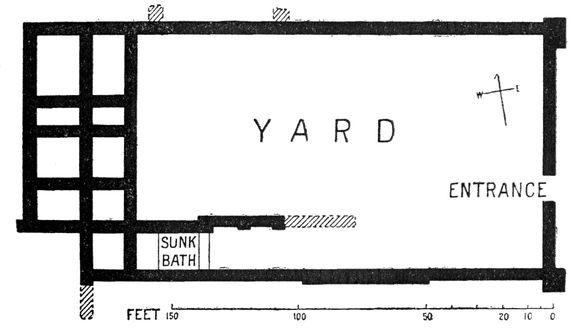
(xxi) A third house is supplied by Kent. This was found in June about six miles south of Gravesend, near the track from North Ash to Ash Church, on the farm of Mr. Geo. Day. Woodland was being cleared for an orchard, flint foundations were encountered, and the site was then explored by Mr. Jas. Kirk, Mr. S. Priest, and others of the Dartford Antiquarian Society, to whom I am indebted for information: the Society will in due course issue a full Report. The spade (fig. 13) revealed a rectangular walled enclosure of 53 × 104 feet. The entrance was at the east end; the dwelling-rooms (including a sunk bath, 7 feet square, lined with plaster) were, so far as traced, in the west and south-west portion; much of the walled space may have been farmyard or wooden sheds. Many bits of Samian and other pottery were found (among them a mortarium stamped MARTINVSF), and many oyster-shells. Other Romano-British foundations have been suspected close by.
