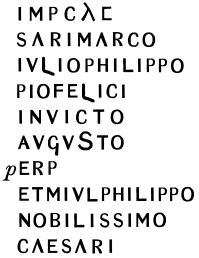
The chief fault in Gough's copy is the omission of line 6, Augusto. This misled Hübner into treating line 7 (ERP) as a blundered reading of that necessary word. In reality, line 7 is the most interesting item in the inscription. It shows that the Emperor Philip was, here at least, styled perpetuus Augustus. That is an appellation to which I find no exact parallel in Philip's other inscriptions or indeed in any other imperial inscriptions till half a century after his death. It fits, however, into a definite development of the Roman imperial titles. In the earliest Empire, phrases occur, mostly on coins, such as Aeternitas imperii or Aeternitas populi romani. Soon the notion of the stability of the Empire was transferred to its rulers. As early as Vespasian, coins bear the legend aeternitas Augusti, and in the first years of the second century Pliny, writing to Trajan, speaks of petitions addressed per salutem tuam aeternitatemque and of 'works worthy of the emperor's eternity,' (opera aeternitate tua digna). Late in the second century such phrases become commoner. With Severus Alexander (A.D. 221-35) coins begin to show the legend Perpetuitas Aug., and before very long the indirect and abstract language changes into direct epithets which are incorporated in the emperors' titulature. The first case which I can find of this is that before us, of Philip (A.D. 244-9); a little later, Aurelian (A.D. 270-5) is styled semper Augustus and, from Diocletian onwards, aeternus, perpetuus, and semper Augustus belong to the customary titulature. Constantine I, for example, is called on one stone invictus et perpetuus ... semper Augustus, on another perpetuus imperator, semper Augustus. That Philip should have been the first to have applied to him, even once, the direct epithet, is probably a mere accident. One might have wished to connect it with his Secular Games, celebrated in 248. But by that time his son was no longer Caesar but full Augustus (since 246), and our stone must fall into the years 244-6.
The ideas underlying these epithets were perhaps mixed. Notions of or prayers for the long life of the Empire, the stability of the reigning house, the long reign of the current emperor, may have jostled with notions of the immortality of the emperors and their deification, and with the eastern ideas which poured into Rome as the second century ended and the third century began.9 The hardening despotism of the imperial constitution, growing more and more autocratic every decade, also helped. As the emperor became unchecked and unqualified monarch, his appellations grew more emphatic; perpetuus Augustus, semper Augustus connoted that unchecked and autocratic rule.
The following summary of the books and articles on Roman Britain which appeared in 1914 is grouped under two heads, first, those few which deal with general aspects of the subject, and secondly, the far larger number which concern special sites or areas. In this second class, those which belong to England are placed under their counties in alphabetical order, while those which belong to Wales and Scotland are grouped under these two headings. I have in general admitted only matter which was published in 1914, or which bears that date.
