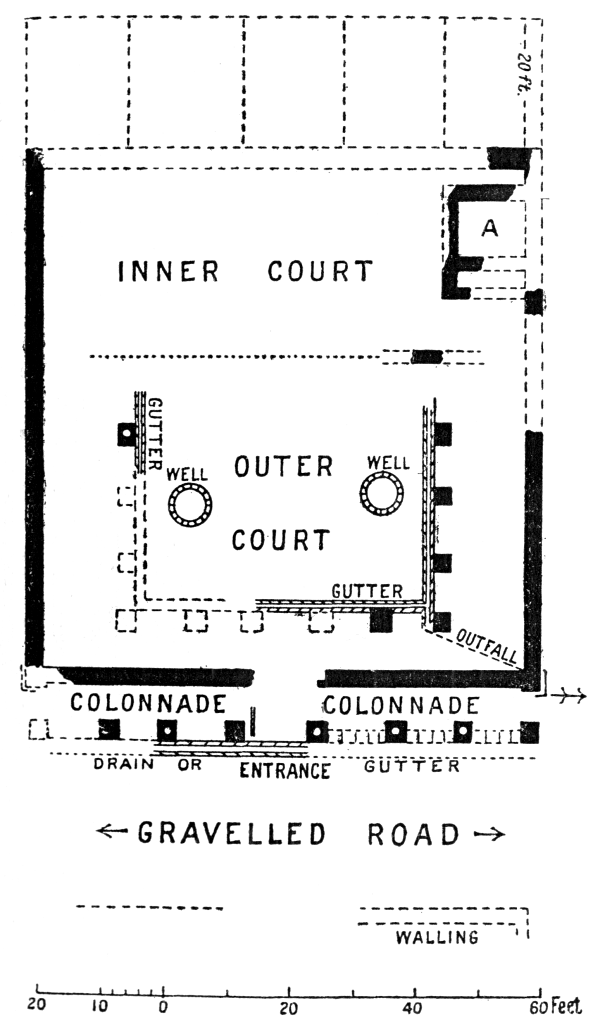
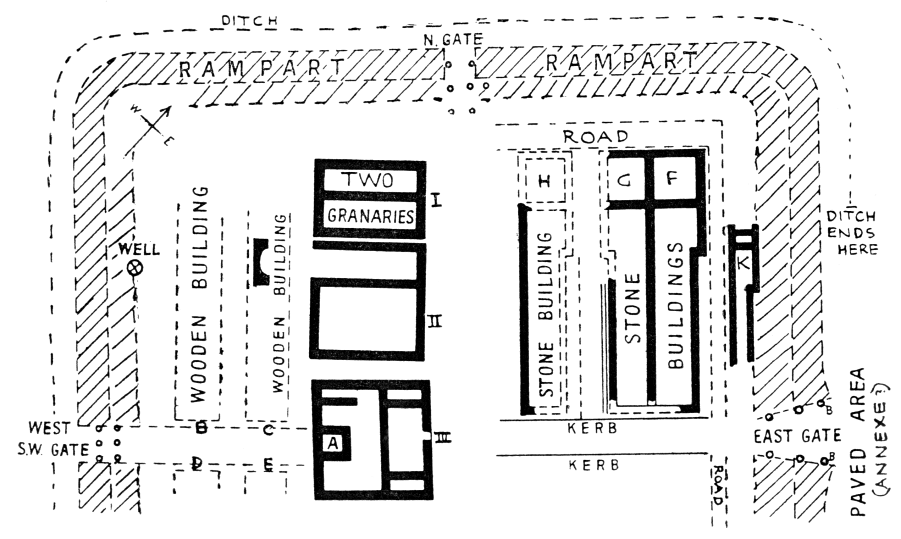
(xi) Slack. The excavation of the Roman fort at Slack, near Huddersfield, noted in my report for 1913 (p. 14), was continued in 1914 by Mr. P. W. Dodd and Mr. A. M. Woodward, lecturers in Leeds University, which is doing good work in the exploration of southern Yorkshire. The defences of the fort, part of its central buildings (fig. 4, I-III), and part of its other buildings (B-K) have now been attacked. The defences consist of (1) a ditch 15 feet wide, possibly double on the north (more exactly north-west) side and certainly absent on the southern two-thirds of the east (north-east) side; (2) a berme, 8 feet wide; and (3) a rampart 20-5 feet thick, built of turf and strengthened by a rough stone base which is, however, only 8-10 feet wide. Of the four gates, three (west, north, and east) have been examined; all are small and have wooden gate-posts instead of masonry. On each side of the east gate, which is the widest (15 ft.), the rampart is thought to thicken as if for greater defence. The absence of a ditch on the southern two-thirds of the east side may be connected with some paving outside the east gate and also with a bath-house, partly explored in 1824 and 1865, outside the south-east (east) corner; we may think that here was an annexe. The central buildings, so far as uncovered, are of stone; the Principia (III) perhaps had some wooden partitions. They are all ill-preserved and call for no further comment. West of them, in the rear of the fort, the excavators traced two long narrow wooden buildings (B, C), north of the road from the west (south-west) gate to the back of the Principia; on the other side of the road they found the ends of two similar buildings (D, E). This looks as if this portion of the fort was filled with four barracks. On the other side of the row of buildings I-III remains were traced of stone structures; one of these (F) had the L-shape characteristic of barracks, and indications point to two others (G, H) of the same shape. This implies six barrack buildings in this portion of the fort and ten barrack buildings in all, that is, a cohort 1,000 strong. But the whole fort is only just 3 acres, and one would expect a smaller garrison; when excavations have advanced, we may perhaps find that the garrison was really a cohors quingenaria with six barracks, as at Gellygaer. Close against the east rampart, and indeed cutting somewhat into it, was a long thin building (K), 12-16 feet wide, which yielded much charcoal and potsherds and seemed an addition to the original plan of the fort.
The few small finds included Samian of the late first and early second centuries (but no '29'), and a denarius of Trajan. In respect of date, they agree with the finds of last year and of 1865, and suggest that the fort was established under Domitian or Trajan, and abandoned under Hadrian or Pius; as an inscription of the Sixth Legion was found here in 1744, apparently in the baths, the evacuation cannot have been earlier than about A.D. 130. The occupation of Slack must therefore have resembled that of Castleshaw, which stands at the western end of the pass through the Pennine Hills, which Slack guards on the east. If this be so, an explanation must be discovered for two altars generally assigned to Slack. One of these, found three miles north of Slack at Greetland in 1597 among traces of buildings, is dated to A.D. 205 (CIL. vii. 200). The other, found two miles eastwards, at Longwood, in 1880 (Eph. Epigr. vii. 920), bears no date; but it was erected by an Aurelius Quintus to the Numina Augustorum, and neither item quite suits so early a date as the reign of Trajan. The dedication of the first is to the goddess Victoria?Vic(toria) Brig(antia)?that of the second deo Berganti (as well as the Numina Aug.); so that in each case a local shrine to a native deity may be concerned. It is also possible that a fort was built near Greetland, after the abandonment of Slack, to guard another pass over the Pennine, that by way of Blackstone Edge.
It is to be hoped that these interesting excavations may be continued and completed.
