by The Open University
Available in 36 free installments
Owner:
This section will concentrate on thinking and specifically how we organise our thoughts, how we make sense of our world and how we remember (or sometimes forget) what is relevant.
Psychologists who study thinking are working in the area of cognitive psychology. Cognition means knowledge so cognitive psychologists are interested in what knowledge people have, how they have acquired this knowledge and how they use this knowledge. This means that the areas they study include attention, perception, memory, problem solving and language.
Organising our thoughts involves:
using mental images
forming concepts (putting information into categories)
developing schemas (constructing mental packages of related information).
We will now look at these three types of organisation in more detail.
As adults, we tend to do most of our thinking in words. However numerous experiments have been carried out that support the suggestion that we will remember verbal or written information better if we also form a mental image of the information. The mental image will give us another cue when we come to recall the information. In addition the effort we make in forming the image will help to fix it in our memory. This works best if the images we form are large colourful and bizarre as we tend to remember distinctive items rather than everyday items.
Using mental images when you first start to learn a new language has proved very effective for helping people grasp basic vocabulary. This is the key word technique. For example take the French word ?poubelle? (pronounced pooh-bell) which translates as ?bin? in English. The first step is to think of an English word or words that sound like the French word or part of the French word. This will give you your key word. Then you make a mental picture of the key word with the English translation. So in this example you could picture yourself lifting the lid off your bin which has turned into a bell and holding your nose because of the ?pooh?.
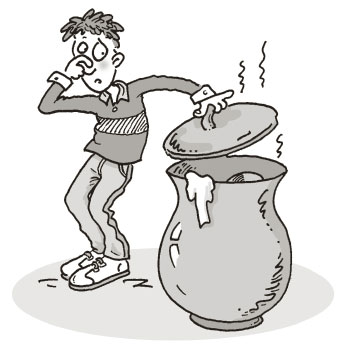 Figure 4: La poubelle
This might sound complicated, but doing it is much simpler than describing it. It is very successful as well as being a lot less effort and more fun than learning lists of vocabulary by repeating the words over and over again.
Michael Raugh and Richard Atkinson (1975) developed this key word technique and carried out an experiment on two groups of participants. The participants were asked to learn a list of 60 Spanish words but only half of them were taught to use the key word technique. When they were tested later the participants using key words scored an average of 88 per cent compared to only 28 per cent for the participants who did not use key words.
This study by Raugh and Atkinson is a good example of a simple experiment. The experimenters had two groups of participants and they manipulated one difference between the two groups. The experimental group were taught to use key words and the control group were not. Both groups were then given a memory test. In experiments the thing that the experimenter manipulates is called the independent variable and the thing that the experimenter measures is called the dependent variable. When researchers design experiments they do need to consider whether any other factors or variables might be influencing their results. It is important that the experimenter tries to eliminate or control these variables.
In the Raugh and Atkinson experiment can you identify the following variables?
the independent variable
the dependent variable
a variable that should be controlled.
