by The Open University
Available in 36 free installments
Owner:
This is a fairly trivial example and that most of us would just write our shopping list down. However hopefully it has demonstrated for you that making mental images can be a powerful aid to memory. The technique can be adapted for other more relevant situations. It has been tested on students revising for exams where it has been found to improve recall. For example if you had to take a psychology exam you could make up mental images of some of the research you have read about and arrange these images in a logical sequence around your home.
Using mental images to organise our thoughts can make our thinking and remembering much more efficient. However there are other organising principles which can also be useful such sorting information into categories.
When we think about the world one of the ways that we organise our thoughts is by putting them into categories. This process of developing categories is called concept formation. For example ?animal? is a concept that contains other sub-concepts and then further sub-concepts. We could divide animals into birds, fish, mammals, etc. We could then divide birds into robins, sparrows, owls, etc. When we apply our concepts we tend to use a set of defining features. For example we would classify the sparrow as a bird because it has a number of defining features that we associate with birds such as wings, feathers, beaks and flying. However although we may have a set of defining features for a concept such as a bird we don't apply these rigidly. Penguins and ostriches are still classified as birds even though they don't fly.
What makes a table a table? We all have a concept of what a table is and can easily recognise a table whether it is a dining table, garden table or coffee table. Can you take a moment to write a list of the defining features of a table?
Most people when asked this relatively simple question will tell you that a table has a flat surface, four legs to raise it off the ground and you can put things on it. They may add other features such as it is an item of furniture or it is often but not always made of wood, but the first three features are the most frequent responses.
However look at the picture below.
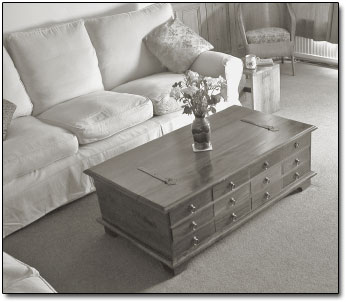 Figure 7: A non-typical table
This table doesn't have four legs but most of us would still recognise it as a table as it has a flat surface that we can put things on.
Similarly our definition of a table as a piece of furniture with a flat surface with four legs could just as easily be applied to a stool.
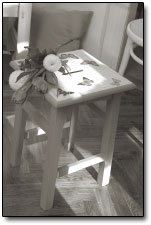 Profimedia International S.R.O/AlamyFigure 8: A stool
So while we would find it difficult to specify a way of distinguishing between a small occasional table and a stool we would not walk into someone's living room and sit on their occasional table because it shares the same the features as a stool. So our concepts are not clearly defined and seem to depend on what we expect to do with an object rather than how we define them. You may have heard the phrase ?fuzzy concept? which reflects our difficulty in providing precise definitions.
So we recognise the object in Figure 7 above as a table because we could use them to put things on such as a book, our drink or an ornament. The object in Figure 8 is a stool because we would sit on it. We will group objects within the same category or concept if we do the same thing with them.
