by The Open University
Available in 36 free installments
Owner:
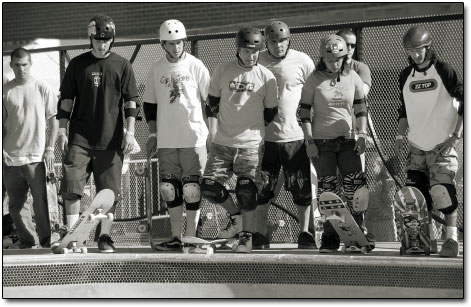 David Young-Wolff/AlamyFigure 11: Skateboarder group
Read the newspaper article below. Can you spot any indications of an ?us and them? kind of thinking? There is more than one ?us and them? indirectly being referred to in the article.
Jonathan Ross sealed his reputation as a man willing to flirt with the unsayable yesterday when live on BBC radio he criticised the concentration of black people in low paid jobs. The target of his wrath? The BBC itself.
Ross, renown as a ?motormouth? chat show host, did not let his reported £6m annual pay stop him speaking his mind about his employer. Presenting his BBC Radio 2 show, he described a visit to the Chris Moyles show on Radio 1 where he met an employee with a small ?Afro? hairstyle. Ross demanded: ?How many black people have they got working on proper shows there? You know the BBC still haven't really come up to speed. I mean they are trying, God bless them.?
?Most of the guys you see there are either working on the door, carrying a cloth in there and cleaning up. We haven't really made the effort yet.?
The subject, which many employers would rather avoid, is especially sensitive at the BBC. Last year Mary FitzPatrick, its ?diversity tsar?, told The Observer she believed foreign correspondents should be from the ethnic background of the country where they are based. She later denied this should be taken as a criticism of the likes of John Simpson and Fergal Keane for being ?too white?.
In 2001 the then director general, Greg Dyke, labelled the BBC ?hideously white? and incapable of retaining staff from ethnic minorities. Last night Dyke took issue with Ross on at least one point: ?It's certainly not true that there hasn't been an effort. While I was there I think we increased the total representation of ethnic minorities by two per cent.?
The BBC scrambled to answer Ross's broadside. A spokeswoman said: ?The BBC is committed to ensuring that the organisation has a mixed and diverse workforce to guarantee a good understanding of the whole BBC audience, which includes people from a wide range of ethnic and social backgrounds.?
She said the BBC was aiming for 12.5 per cent ethnic minority employees in the workforce and seven per cent in senior management by December 2007. ?As far as what Jonathan Ross said, he was expressing his personal opinions.?
(Smith, 2007)
The clearest reference to ?us and them? is probably ?blacks versus whites in the BBC?. Did you pick any others up such as ?BBC workers versus front-line presenters? or ?BBC employees versus senior management?? Often, notions of ?us and them? are subtle and can be hard to spot unless you're a part of the in-group/out-group conflict.
Interest in the process of identification with groups received a strong impetus from a series of studies conducted in the 1950s and 1960s. Muzafer Sherif et al (1961), for instance, conducted an often cited series of experiments involving a boys? summer camp.
The experimenters divided the boys into two groups. As expected the groups became quite cohesive involving norms of behaviour, jokes and secret codes. They set up a competition in the form of a tournament. Good sportsmanship quickly degenerated into overt group hostility with name-calling, aggression and prejudice in evidence. Within the groups, however, group loyalty, solidarity and cooperation were at its height. The experimenters then further manipulated the group situation by introducing activities which required both groups to actively cooperate and positively work together. This proved quite successful.
