by The Open University
Available in 36 free installments
Owner:
The evidence suggests that the desire for self-esteem leads to inter-group competition and that these processes can escalate into open hostility and discrimination. In other words, simply categorising people into groups may be sufficient to generate conflict and prejudice between groups. The argument here is that individual differences between members of both in-groups and out-groups tend to be ignored. This results in stereotyping: the over-simplified, distorted, and one-dimensional portrayal of people, perhaps based on their sex, race, religion, profession or age. For instance, think about the stereotype of ?dumb blondes? which suggests that all blonde women are stupid when the reality is that intelligence is not related to hair colour. Then there are more serious examples of stereotypes, for example, when a Muslim is wrongly assumed to be a ?terrorist?. This occurs in people's thinking as a way of simplifying and organising a complex world. The problem with such unfortunate stereotypes is that they can have problematic, even critical, consequences.
Psychologists who have studied this subject argue that as we seek to make sense of our complicated, confusing world, we inevitably stereotype people to some degree. In a sense, people have to simplify and make generalisations. The problem arises when negative caricatures result in prejudice and are used to justify discrimination against one group by another. Such portrayals can profoundly affect how we value ourselves and relate to one another in groups.
In the 1950s, Solomon Asch conducted what are now regarded as classic experiments on how individuals can be pressured to conform to a group's standard. The results of his experiments dramatically showed the influence of group pressure.
The following passage describes one of Asch's experiments. As you read, try to imagine that you are a participant yourself in the experiment and guess how you might have responded.
You are seated round a table with six other people taking part in an experiment on the ways we perceive things. Your group is shown a picture of a straight line. You're all then given a picture of three more lines of different lengths. You are asked to pick out the line equal in length to the original one, as below.
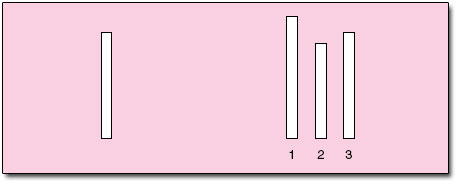 Figure 12: Different length lines
Is this line length similar to line 1, 2 or 3?
Each person at the round table identifies their own choice out loud ? you're the last but one to speak. The first five people opt for line 2. Do you agree with them?
Can you think of one occasion in real life where you have been subjected to some form of group pressure? Perhaps you were in a pub and your friends pressed you to have another drink and stay a bit longer, when really you wanted to leave. What happened and what did you do? What, if anything, would have swayed you to go along with the group? Write some brief notes describing your experience.
In Asch's experiment this exercise was done many times with different line lengths. What you won't have realised is that the people in the experimental group, bar one participant, were actually in league with the experimenter and occasionally gave the same false answers deliberately! What was being tested was whether or not the one genuine participant felt the group pressure to conform to the others' opinions. So, did you?
Of course it is impossible to say with this paper exercise whether or not you really would have actually succumbed to the influence of the group pressure. What might have happened would be for you to conform publicly but disagree privately. (This is something that happened quite a lot in Asch's experiment too.)
