by The Open University
Available in 36 free installments
Owner:
When answering the question ?What makes us who we are??, psychologists ? as you now know ? put forward a range of explanations about why people feel, think and behave the way they do. Just when psychologists seem to understand one bit of ?who we are?, up pops some new evidence to show a different side! It is not easy to pin down all the many influences.
Each of the previous sections of this unit has focused on one approach to explaining ?What makes us who we are??. In this section you will have the opportunity to combine a number of different possible explanations to try and get a more complete picture of why a person thinks or acts in a certain way. You have seen, from your reading of previous sections, how people can be influenced by different aspects such as their brain and biology, thinking, relationships and social identities and how different types of psychologists (biological, cognitive, developmental and social) tend to favour certain explanations. Now it's time to put those pieces together and recognise that there are invariably multiple influences at work. This is the key lesson of this section.
This section will examine the multiple and interlinking influences at work on people's minds and behaviour coming from both inside and outside the individual.
Human beings are complex and it's rarely easy to work out exactly why someone thinks or behaves in a certain way. An interplay of factors are invariably involved both within the individual themselves and outside to do with their wider social context. Factors within the individual include their biology, their thoughts and their feelings. Influencing factors coming from outside include things like relationships, social identities and the wider culture.
However, what is happening ?inside? and ?outside? a person is invariably interconnected. For example, when we think about something, it's usually related to something outside ourselves. Other psychologists argue that the inside is really a reflection of what's going on outside so it can't be separated out. ?There is no inner man?, a philosopher called Maurice Merleau-Ponty explains, ?man is in the world, and only in the world does he know himself? (1962, p. xi). That said, the words ?inside? and ?outside? offer a useful short-hand description (and one that fits this unit nicely): ?inside? factors are the ones discussed in Sections 2 and 3 while the ?outside? factors are explored in Sections 4 and 5. Looked at another way, you can see the ?inside? referring to personal factors to do with the individual themselves, while the ?outside? relates to social influences where other people are involved.
What follows is a case study which will give you an opportunity to think about a number of different influences on a person's behaviour.
The case study to be considered is an incident from the 2006 World Cup Final between France and Italy. The two players involved are Zinedine Zidane, playing for France who head-butted the chest of Marco Materazzi, who was playing for Italy.
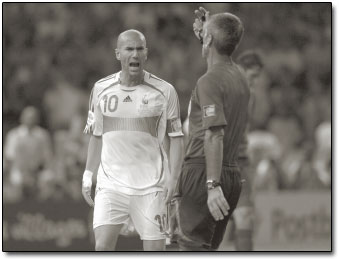 Copyright Popperfoto/AlamyFigure 13: Zidane
Read the following description of the incident, and note down any thoughts you have about what happened.
