by The Open University
Available in 36 free installments
Owner:
Early researchers were puzzled by the fact that people who had undergone this operation did not show any noticeable changes in behaviour, personality or their scores on intelligence tests despite such extensive surgery. In fact they wondered what the purpose of the corpus callosum was if you could cut through it with so little effect. However careful testing by Roger Sperry (1968) and colleagues did uncover behaviour that was far from normal. This work was to gain him a Nobel Prize for Medicine in 1981.
Sperry et al, devised a number of split brain experiments using people who had had split brain surgery as participants and comparing their responses to people who had not had this surgery. In one experiment the split brain participant was blindfolded and given objects to explore with their left hand. Information from the left hand goes to the right hemisphere but speech is generally controlled by the left hemisphere.
Participants were unable to tell the experimenter the name of the object they were holding in their left hand even though they could obviously recognise the object because they would make appropriate gestures with it. For example, if the object was a key they would hold it out as though putting it in a lock and turn it. Because the right hemisphere does not talk and could not transfer information to the left hemisphere the object cannot be named. However as soon as the participant touched the object with the right hand they were able to name it instantly.
In another experiment the participant would sit at a table with a screen in front of them. They would be asked to place their hands round the sides of the screen so that their hands were hidden from view. They would then be asked to fix their eyes on a spot in the centre of the screen.
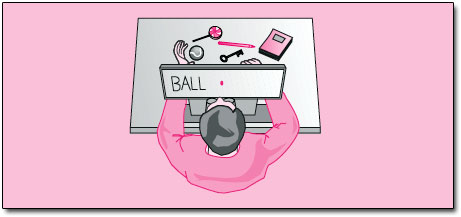 Figure 3: A split brain study
A word is then flashed onto one side of the screen very briefly (approximately one tenth of a second). The word has to be flashed very quickly so that the participant does not have time to move their eyes and the information will only go to one of the brain hemispheres.
When a word is flashed on to the left-hand side of the screen the information will go to the right hemisphere of the brain. The information cannot be passed to the talkative left hemisphere so the participant cannot tell the experimenter what the word was.
However the participant can use their left hand to explore a pile of objects behind the screen and easily pick out the object that corresponds to the word that has been flashed up. They still won't be able to tell the experimenter what the left hand is doing as sensory information from the left hand is going to the silent right hemisphere only. Also they can't find the right object with their right hand as the right hand is controlled by the left hemisphere and the left hemisphere did not see the flashed word.
Reading about split brain experiments can be a little confusing as you try and sort out right and left hands, hemispheres and sides of the screen. Taking some time to do this activity should help to make things clearer.
1 If a word is flashed on the right hand of the screen will a person with a split brain be able to:
| Yes | No | |
|---|---|---|
| (a) name the word | ||
| (b) pick out the corresponding object from behind the screen with their right hand | ||
| (c) pick out the corresponding object from behind the screen with their left hand |
Don't worry if you found this activity difficult. Many people find following a path from a word on the right side of the screen to the left hemisphere of the brain and then to the right hand far from easy.
