by Wikibooks, open books for an open world
Available in 123 free installments
Owner:
If we study the propagation of a sound wave, far from the acoustic source, it can be considered as a plane 1D wave. If the direction of propagation is along the x axis, the solution is:

where f and g can be any function. f describes the wave motion toward increasing x, whereas g describes the motion toward decreasing x.
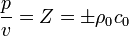
The momentum equation provides a relation between p and  which leads to the expression of the specific impedance, defined as follows:
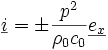
And still in the case of a plane wave, we get the following expression for the acoustic intensity:
More generally, the waves propagate in any direction and are spherical waves. In these cases, the solution for the acoustic potential ? is:

The fact that the potential decreases linearly while the distance to the source rises is just a consequence of the conservation of energy. For spherical waves, we can also easily calculate the specific impedance as well as the acoustic intensity.
