by Wikibooks, open books for an open world
Available in 123 free installments
Owner:
A more accurate expression for the speed of sound is

where
In the standard atmosphere :
T0 is 273.15 K (= 0 °C = 32 °F), giving a value of 331.5 m/s (= 1087.6 ft/s = 1193 km/h = 741.5 mph = 643.9 knots).
T20 is 293.15 K (= 20 °C = 68 °F), giving a value of 343.4 m/s (= 1126.6 ft/s = 1236 km/h = 768.2 mph = 667.1 knots).
T25 is 298.15 K (= 25 °C = 77 °F), giving a value of 346.3 m/s (= 1136.2 ft/s = 1246 km/h = 774.7 mph = 672.7 knots).
In fact, assuming an ideal gas, the speed of sound c depends on temperature only, not on the pressure. Air is almost an ideal gas. The temperature of the air varies with altitude, giving the following variations in the speed of sound using the standard atmosphere - actual conditions may vary. Any qualification of the speed of sound being "at sea level" is also irrelevant.
| Altitude | Temperature | m/s | km/h | mph | knots |
| Sea level (?) | 15 °C (59 °F) | 340 | 1225 | 761 | 661 |
| 11,000 m?20,000 m (Cruising altitude of commercial jets, and first supersonic flight) |
-57 °C (-70 °F) | 295 | 1062 | 660 | 573 |
| 29,000 m (Flight of X-43A) | -48 °C (-53 °F) | 301 | 1083 | 673 | 585 |
In a Non-Dispersive Medium ? Sound speed is independent of frequency, therefore the speed of energy transport and sound propagation are the same. For audio sound range air is a non-dispersive medium. We should also note that air contains CO2 which is a dispersive medium and it introduces dispersion to air at ultrasound frequencies (28KHz).
In a Dispersive Medium ? Sound speed is a function of frequency. The spatial and temporal distribution of a propagating disturbance will continually change. Each frequency component propagates at each its own phase speed, while the energy of the disturbance propagates at the group velocity. Water is an example of a dispersive medium.
In general, the speed of sound c is given by

where
Thus the speed of sound increases with the stiffness of the material, and decreases with the density.
In a fluid the only non-zero stiffness is to volumetric deformation (a fluid does not sustain shear forces).
Hence the speed of sound in a fluid is given by

where
For a gas, K is approximately given by

where
Thus, for a gas the speed of sound can be calculated using:

which using the ideal gas law is identical to:
(Newton famously considered the speed of sound before most of the development of thermodynamics and so incorrectly used isothermal calculations instead of adiabatic. His result was missing the factor of ? but was otherwise correct.)
In a solid, there is a non-zero stiffness both for volumetric and shear deformations. Hence, in a solid it is possible to generate sound waves with different velocities dependent on the deformation mode.
In a solid rod (with thickness much smaller than the wavelength) the speed of sound is given by:

where
Thus in steel the speed of sound is approximately 5100 m/s.
In a solid with lateral dimensions much larger than the wavelength, the sound velocity is higher. It is found by replacing Young's modulus with the plane wave modulus, which can be expressed in terms of the Young's modulus and Poisson's ratio as:
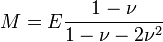
For air, see density of air.
The speed of sound in water is of interest to those mapping the ocean floor. In saltwater, sound travels at about 1500 m/s and in freshwater 1435 m/s. These speeds vary due to pressure, depth, temperature, salinity and other factors.
For general equations of state, if classical mechanics is used, the speed of sound c is given by

where differentiation is taken with respect to adiabatic change.
If relativistic effects are important, the speed of sound S is given by:
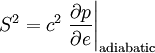
(Note that  is the relativisic internal energy density).
This formula differs from the classical case in that ? has been replaced by  .
.
