by Wikibooks, open books for an open world
Available in 123 free installments
Owner:
As explained previously, there are two main types of filters used in practice: absorptive and reactive. The benefits and drawback of each will be briefly explained, along with their relative applications (see [Absorptive Mufflers].
These are mufflers which incorporate sound absorbing materials to transform acoustic energy into heat. Unlike reactive mufflers which use destructive interference to minimize radiated sound power, absorptive mufflers are typically straight through pipes lined with multiple layers of absorptive materials to reduce radiated sound power. The most important property of absorptive mufflers is the attenuation constant. Higher attenuation constants lead to more energy dissipation and lower radiated sound power.
| Advantages of Absorptive Mufflers [3]: |
| (1) - High amount of absorption at larger frequencies.
(2) - Good for applications involving broadband (constant across the spectrum) and narrowband (see [1]) noise. (3) - Reduced amount of back pressure compared to reactive mufflers. |
| Disadvantages of Absorptive Mufflers [3]: |
| (1) - Poor performance at low frequencies.
(2) - Material can degrade under certain circumstances (high heat, etc). |
 Absorptive Muffler
There are a number of applications for absorptive mufflers. The most well known application is in race cars, where engine performance is desired. Absorptive mufflers don't create a large amount of back pressure (as in reactive mufflers) to attenuate the sound, which leads to higher muffler performance. It should be noted however, that the radiate sound is much higher. Other applications include plenum chambers (large chambers lined with absorptive materials, see picture below), lined ducts, and ventilation systems.
Reactive mufflers use a number of complex passages (or lumped elements) to reduce the amount of acoustic energy transmitted. This is accomplished by a change in impedance at the intersections, which gives rise to reflected waves (and effectively reduces the amount of transmitted acoustic energy). Since the amount of energy transmitted is minimized, the reflected energy back to the source is quite high. This can actually degrade the performance of engines and other sources. Opposite to absorptive mufflers, which dissipate the acoustic energy, reactive mufflers keep the energy contained within the system. See [Reactive Mufflers] for more information.
| Advantages of Reactive Mufflers [3]: |
| (1) - High performance at low frequencies.
(2) - Typically give high insertion loss, IL, for stationary tones. (3) - Useful in harsh conditions. |
| Disadvantages of Reactive Mufflers [3]: |
| (1) - Poor performance at high frequencies.
(2) - Not desirable characteristics for broadband noise. |
 Reflective Muffler
Reactive mufflers are the most widely used mufflers in combustion engines[1]. Reactive mufflers are very efficient in low frequency applications (especially since simple lumped element analysis can be applied). Other application areas include: harsh environments (high temperature/velocity engines, turbines, etc), specific frequency attenuation (using a helmholtz like device, a specific frequency can be toned to give total attenuation of radiated sound power), and a need for low radiated sound power (car mufflers, air conditioners, etc).
There are 3 main metrics used to describe the performance of mufflers; Noise Reduction, Insertion Loss, and Transmission Loss. Typically when designing a muffler, 1 or 2 of these metrics is given as a desired value.
Defined as the difference between sound pressure levels on the source and receiver side. It is essentially the amount of sound power reduced between the location of the source and termination of the muffler system (it doesn't have to be the termination, but it is the most common location) [3].

where Lp1 and Lp2 is sound pressure levels at source and receiver respectively. Although NR is easy to measure, pressure typically varies at source side due to standing waves [3].
Defined as difference of sound pressure level at the receiver with and without sound attenuating barriers. This can be realized, in a car muffler, as the difference in radiated sound power with just a straight pipe to that with an expansion chamber located in the pipe. Since the expansion chamber will attenuate some of the radiate sound power, the pressure at the receiver with sound attenuating barriers will be less. Therefore, a higher insertion loss is desired [3].

where Lp,without and Lp,with are pressure levels at receiver without and with a muffler system respectively. Main problem with measuring IL is that the barrier or sound attenuating system needs to be removed without changing the source [3].
Defined as the difference between the sound power level of the incident wave to the muffler system and the transmitted sound power. For further information see [Transmission Loss] [3].
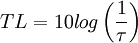 with
with 
where It and Ii are the transmitted and incident wave power respectively. From this expression, it is obvious the problem with measure TL is decomposing the sound field into incident and transmitted waves which can be difficult to do for complex systems (analytically).
(1) - For a plenum chamber (see figure below):
 in dB
in dB
where ? is average absorption coefficient.
 Plenum Chamber
|
 Transmission Loss vs. Theta
|
(2) - For an expansion (see figure below):
![NR = 10log\left[ \frac{1}{2}\left| e^{-ikx_{s}}+\left( \frac{1-S}{1+S} \right)e^{ikx_{s}} \right|^2\left( 1+S \right)^2 \right]](11ce2506a1476d33a7324b939e794c83.png)
![IL = 10log\left[ \frac{\left( 1+S \right)^2}{4} \right]](7a69448b0eb8e442b98595e671226b9a.png)
![TL = 10log\left[ \frac{\left( 1+S \right)^2}{4S} \right]](34000628ab1e105c68bec90fcc4a846f.png)
where 
 Expansion in Infinite Pipe
|
 NR, IL, & TL for Expansion
|
(3) - For a helmholtz resonator (see figure below):
![TL = 10log\left[ 1+\left( \frac{\left( \frac{c}{2S_{b}} \right)}{\omega LS - \left( \frac{c^2}{\omega V} \right)} \right)^2 \right]](e1a5a424ad17d57568b455913d77c910.png) in dB
in dB
 Helmholtz Resonator
|
 TL for Helmholtz Resonator
|
gdnrb
