by Wikibooks, open books for an open world
Available in 123 free installments
Owner:
Sound waves consist in the propagation of a scalar quantity, acoustic over-pressure. The propagation of sound waves in a stationary medium (e.g. still air or water) is governed by the following equation (see wave equation):
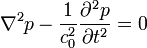
This equation is obtained using the conservation equations (mass, momentum and energy) and the thermodynamic equations of state of an ideal gas (or of an ideally compressible solid or liquid), supposing that the pressure variations are small, and neglecting viscosity and thermal conduction, which would give other terms, accounting for sound attenuation.
In the propagation equation of sound waves, c0 is the propagation velocity of the sound wave (which has nothing to do with the vibration velocity of the air layers). This propagation velocity has the following expression:
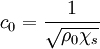
where ?0 is the density and ?S is the compressibility coefficient of the propagation medium.
