by Wikibooks, open books for an open world
Available in 123 free installments
Owner:
Since the velocity field  for acoustic waves is irrotational we can define an acoustic potential ? by:

Using the propagation equation of the previous paragraph, it is easy to obtain the new equation:
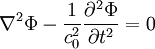
Applying the Fourier Transform, we get the widely used Helmoltz equation:

where k is the wave number associated with ?. Using this equation is often the easiest way to solve acoustical problems.
