by Wikibooks, open books for an open world
Available in 123 free installments
Owner:
It can be shown [2] that for ka < 1 / 2, a loudspeaker behaves as a spherical source. Here, a represents the radius of the loudspeaker. For a 15? diameter loudspeaker in air, this low frequency limit is about 150 Hz. For smaller loudspeakers, this limit increases. This limit dominates the limit which ignores LE, and is consistent with the limit that models ZRAD by MA1.
Within this limit, the loudspeaker emits a volume velocity U0, as determined in the previous section. For a simple spherical source with volume velocity U0, the far-field pressure is given by [1]:
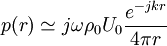
It is possible to simply let r = 1 for this analysis without loss of generality because distance is only a function of the surroundings, not the loudspeaker. Also, because the transfer function magnitude is of primary interest, the exponential term, which has a unity magnitude, is omitted. Hence, the pressure response of the system is given by [1]:

Where H(s) = sG(s). In the following sections, design methods will focus on | H(s) | 2 rather than H(s), which is given by:
 |
 |
This also implicitly ignores the constants in front of | H(s) | since they simply scale the response and do not affect the shape of the frequency response curve.
