by Wikibooks, open books for an open world
Available in 123 free installments
Owner:
The Butterworth algorithm is designed to have a maximally flat pass band. Since the slope of a function corresponds to its derivatives, a flat function will have derivatives equal to zero. Since as flat of a pass band as possible is optimal, the ideal function will have as many derivatives equal to zero as possible at s = 0. Of course, if all derivatives were equal to zero, then the function would be a constant, which performs no filtering.
Often, it is better to examine what is called the loss function. Loss is the reciprocal of gain, thus
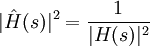
The loss function can be used to achieve the desired properties, then the desired gain function is recovered from the loss function.
Now, applying the desired Butterworth property of maximal pass-band flatness, the loss function is simply a polynomial with derivatives equal to zero at s = 0. At the same time, the original polynomial must be of degree eight (yielding a fourth-order function). However, derivatives one through seven can be equal to zero if [3]

With the high-pass transformation  ,
,
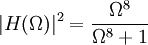
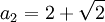
It is convenient to define ? = ? / ?3dB, since  or -3 dB. This defintion allows the matching of coefficients for the | H(s) | 2 describing the loudspeaker response when ?3dB = ?0. From this matching, the following design equations are obtained [1]:
 |
 |
