by Wikibooks, open books for an open world
Available in 123 free installments
Owner:
The Chebyshev algorithm is an alternative to the Butterworth algorithm. For the Chebyshev response, the maximally-flat passband restriction is abandoned. Now, a ripple, or fluctuation is allowed in the pass band. This allows a steeper transition or roll-off to occur. In this type of application, the low-frequency response of the loudspeaker can be extended beyond what can be achieved by Butterworth-type filters. An example plot of a Chebyshev high-pass response with 0.5 dB of ripple against a Butterworth high-pass response for the same ?3dB is shown below.

Figure 6: Chebyshev vs. Butterworth High-Pass Response.
The Chebyshev response is defined by [4]:

Cn(?) is called the Chebyshev polynomial and is defined by [4]:
 |
cos[ncos ? 1(?)] | | ? | < 1 |
| cosh[ncosh ? 1(?)] | | ? | > 1 |
Fortunately, Chebyshev polynomials satisfy a simple recursion formula [4]:
| C0(x) = 1 | C1(x) = x | Cn(x) = 2xCn ? 1 ? Cn ? 2 |
For more information on Chebyshev polynomials, see the Wolfram Mathworld: Chebyshev Polynomials page.
When applying the high-pass transformation to the 4th order form of  , the desired response has the form [1]:
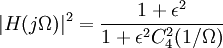
The parameter ? determines the ripple. In particular, the magnitude of the ripple is 10log[1 + ?2] dB and can be chosen by the designer, similar to B in the quasi-Butterworth case. Using the recursion formula for Cn(x),

Applying this equation to | H(j?) | 2 [1],
 |
|
 |
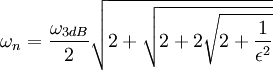 |
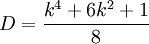
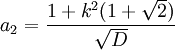
Thus, the design equations become [1]:
![\omega_0 = \omega_n\sqrt[8]{\frac{64\epsilon^2}{1+\epsilon^2}}](55646830cdcfd897eef2ce380b328e1d.png) |
![k = \rm{tanh}\left[\frac{1}{4}\rm{sinh}^{-1}\left(\frac{1}{\epsilon}\right)\right]](20c10d48cbbfe9e4141a0bdd31bc3747.png) |
 |
![a_1 = \frac{k\sqrt{4 + 2\sqrt{2}}}{\sqrt[4]{D}},](f767abcfe1e45f852ed281acb672ea2b.png) |
 |
![a_3 = \frac{a_1}{\sqrt{D}}\left[1 - \frac{1 - k^2}{2\sqrt{2}}\right]](e2c4720cd47e8c4dc94f5a4c7e69e7d0.png) |
