by Wikibooks, open books for an open world
Available in 104 free installments
Owner:
Two questions are given below to help you develop your understanding of the material presented in this chapter. The first one is relatively straight-forward and will exercise your application of the exponential attenuation equation. The second question is a lot more challenging and will help you relate exponential attenuation to radioactivity and radiation exposure.
Question 1
How much aluminium is required to reduce the intensity of a 200 keV gamma-ray beam to 10% of its incident intensity? Assume that the Half Value Layer for 200 keV gamma-rays in Al is 2.14 cm.
Answer
The question phrased in terms of the symbols used above is:
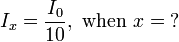
We are told that the Half Value Layer is 2.14 cm. Therefore the Linear Attenuation Coefficient is

Now combining all this with the exponential attenuation equation:

we can write:
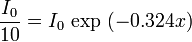
Therefore
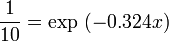



So the thickness of aluminium required to reduce these gamma-rays by a factor of ten is about 7 cm. This relatively large thickness is the reason why aluminium is not generally used in radiation protection - its atomic number is not high enough for efficient and significant attenuation of gamma-rays.
You might like to try this question for the case when Pb is the absorber - but you will need to find out the Half Value Layer for the 200 keV gamma-rays yourself!
Here's a hint though: have a look at one of the tables above.
And here's the answer for you to check when you've finished: 2.2 mm.
In other words a relatively thin thickness of Pb is required to do the same job as 7 cm of aluminium.
Question 2
A 105 MBq source of 137Cs is to be contained in a Pb box so that the exposure rate 1 m away from the source is less than 0.5 mR/hour. If the Half Value Layer for 137Cs gamma-rays in Pb is 0.6 cm, what thickness of Pb is required? The Specific Gamma Ray Constant for 137Cs is 3.3 R hr-1 mCi-1 at 1 cm.
Answer
This is a fairly typical question which arises when someone is using radioactive materials. We wish to use a certain quantity of the material and we wish to store it in a lead container so that the exposure rate when we are working a certain distance away is below some level for safety reasons. We know the radioactivity of the material we will be using. But its quoted in SI units. We look up a reference book to find out the exposure rate for this radioisotope and find that the Specific Gamma Ray Constant is quoted in traditional units. Just as in our question!
So let us start by getting our units right. The Specific Gamma Ray Constant is given as:
3.3 R hr-1 mCi-1 at 1 cm from the source.This is equal to:
3300 mR hr-1 mCi-1 at 1 cm from the source,which is equal to:

on the basis of the Inverse Square Law. This result expressed per becquerel is

since 1 mCi = 3.7 x 10⁷ Bq. And therefore for 105 MBq, the exposure rate is:

That is the exposure rate 1 meter from our source is 891.9 mR hr-1.
We wish to reduce this exposure rate according to the question to less than 0.5 mR hr-1 using Pb.
You should be able at this stage to use the exponential attenuation equation along with the Half Value Layer for these gamma-rays in Pb to calculate that the thickness of Pb required is about 6.5 cm.
