by Various
Available in 585 free installments
Owner:
M = ½we(c-x)(c+x).
Putting x = 0, for the centre section
Mc = ½wec2;
and putting x = ½c, for section at quarter span
Ma = ?wec2.
From these equations a value of we can be obtained. Then the bridge is designed, so far as the direct stresses are concerned, for bending moments due to a uniform dead load and the uniform equivalent load we.
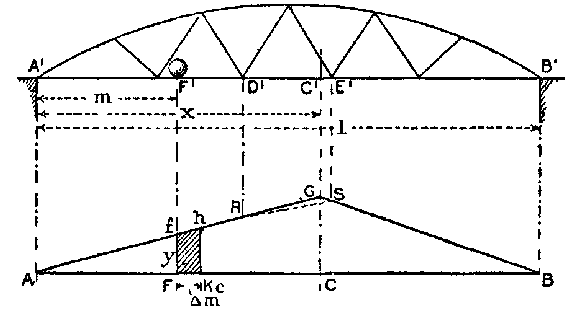 Fig. 52.
27. Influence Lines.?In dealing with the action of travelling loads much assistance may be obtained by using a line termed an influence line. Such a line has for abscissa the distance of a load from one end of a girder, and for ordinate the bending moment or shear at any given section, or on any member, due to that load. Generally the influence line is drawn for unit load. In fig. 52 let A?B? be a girder supported at the ends and let it be required to investigate the bending moment at C? due to unit load in any position on the girder. When the load is at F?, the reaction at B? is m/l and the moment at C? is m(l-x)/l, which will be reckoned positive, when it resists a tendency of the right-hand part of the girder to turn counter-clockwise. Projecting A?F?C?B? on to the horizontal AB, take Ff = m(l-x)/l, the moment at C of unit load at F. If this process is repeated for all positions of the load, we get the influence line AGB for the bending moment at C. The area AGB is termed the influence area. The greatest moment CG at C is x(l-x)/l. To use this line to investigate the maximum moment at C due to a series of travelling loads at fixed distances, let P1, P2, P3, ... be the loads which at the moment considered are at distances m1, m2, ... from the left abutment. Set off these distances along AB and let y1, y2, ... be the corresponding ordinates of the influence curve (y = Ff) on the verticals under the loads. Then the moment at C due to all the loads is
M = P1y1+P2y2+...
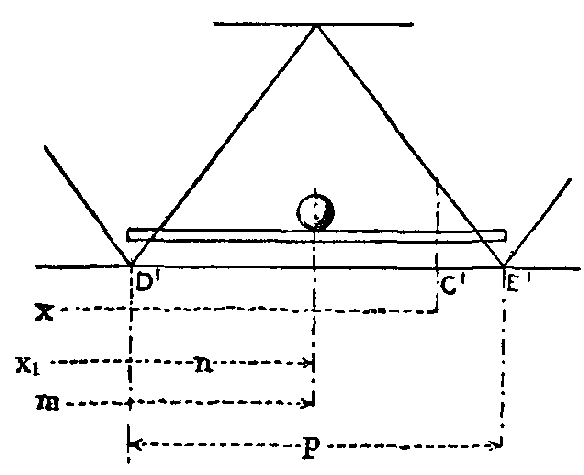 Fig. 53.
The position of the loads which gives the greatest moment at C may be settled by the criterion given above. For a uniform travelling load w per ft. of span, consider a small interval Fk = ?m on which the load is w?m. The moment due to this, at C, is wm(l-x)?m/l. But m(l-x)?m/l is the area of the strip Ffhk, that is y?m. Hence the moment of the load on ?m at C is wy?m, and the moment of a uniform load over any portion of the girder is w × the area of the influence curve under that portion. If the scales are so chosen that a inch represents 1 in. ton of moment, and b inch represents 1 ft. of span, and w is in tons per ft. run, then ab is the unit of area in measuring the influence curve.
If the load is carried by a rail girder (stringer) with cross girders at the intersections of bracing and boom, its effect is distributed to the bracing intersections D?E? (fig. 53), and the part of the influence line for that bay (panel) is altered. With unit load in the position shown, the load at D? is (p-n)/p, and that at E? is n/p. The moment of the load at C is m(l-x)/l-n(p-n)/p. This is the equation to the dotted line RS (fig. 52).
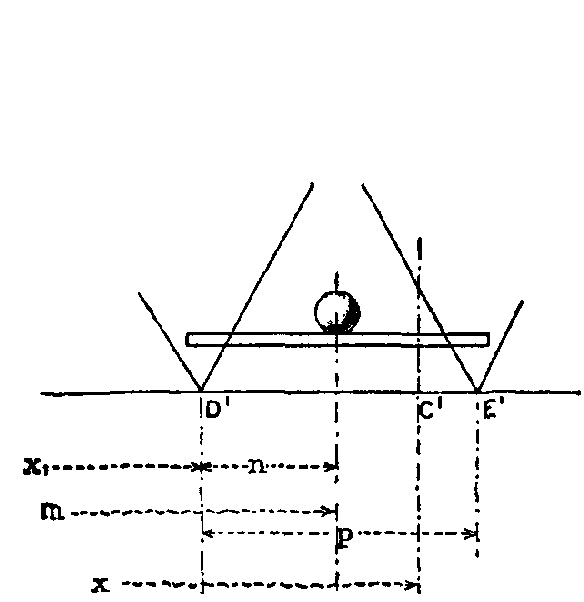 Fig. 55
