by Various
Available in 585 free installments
Owner:
If the unit load is at F?, the reaction at B? and the shear at C? is m/l, positive if the shearing stress resists a tendency of the part of the girder on the right to move upwards; set up Ff = m/l (fig. 54) on the vertical under the load. Repeating the process for other positions, we get the influence line AGHB, for the shear at C due to unit load anywhere on the girder. GC = x/l and CH = -(l-x)/l. The lines AG, HB are parallel. If the load is in the bay D?E? and is carried by a rail girder which distributes it to cross girders at D?E?, the part of the influence line under this bay is altered. Let n (Fig. 55) be the distance of the load from D?, x1 the distance of D? from the left abutment, and p the length of a bay. The loads at D?, E, due to unit weight on the rail girder are (p-n)/p and n/p. The reaction at B? is {(p-n)x1+n(x1+p)}/pl. The shear at C? is the reaction at B? less the load at E?, that is, {p(x1+n)-nl}/pl, which is the equation to the line DH (fig. 54). Clearly, the distribution of the load by the rail girder considerably alters the distribution of shear due to a load in the bay in which the section considered lies. The total shear due to a series of loads P1, P2, ... at distances m1, m2, ... from the left abutment, y1, y2, ... being the ordinates of the influence curve under the loads, is S = P1y1+P2y2+.... Generally, the greatest shear S at C will occur when the longer of the segments into which C divides the girder is fully loaded and the other is unloaded, the leading load being at C. If the loads are very unequal or unequally spaced, a trial or two will determine which position gives the greatest value of S. The greatest shear at C? of the opposite sign to that due to the loading of the longer segment occurs with the shorter segment loaded. For a uniformly distributed load w per ft. run the shear at C is w × the area of the influence curve under the segment covered by the load, attention being paid to the sign of the area of the curve. If the load rests directly on the main girder, the greatest + and - shears at C will be w × AGC and -w × CHB. But if the load is distributed to the bracing intersections by rail and cross girders, then the shear at C? will be greatest when the load extends to N, and will have the values w × ADN and -w × NEB. An interesting paper by F.C. Lea, dealing with the determination of stress due to concentrated loads, by the method of influence lines will be found in Proc. Inst. C.E. clxi. p.261.
Influence lines were described by Fränkel, Der Civilingenieur, 1876. See also Handbuch der Ingenieur-wissenschaften, vol. ii. ch. x. (1882), and Levy, La Statique graphique (1886). There is a useful paper by Prof. G.F. Swain (Trans. Am. Soc. C.E. xvii., 1887), and another by L.M. Hoskins (Proc. Am. Soc. C.E. xxv., 1899).
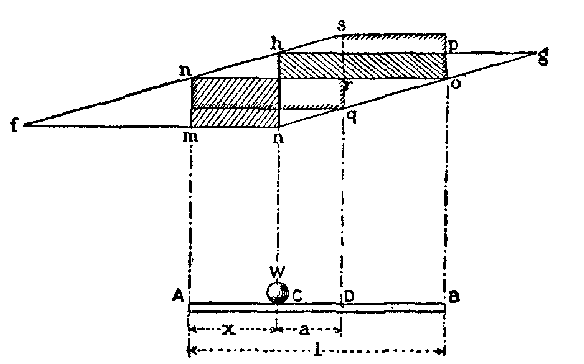 Fig. 56.
28. Eddy's Method.?Another method of investigating the maximum shear at a section due to any distribution of a travelling load has been given by Prof. H.T. Eddy (Trans. Am. Soc. C.E. xxii., 1890). Let hk (fig. 56) represent in magnitude and position a load W, at x from the left abutment, on a girder AB of span l. Lay off kf, hg, horizontal and equal to l. Join f and g to h and k. Draw verticals at A, B, and join no. Obviously no is horizontal and equal to l. Also mn/mf = hk/kf or mn-W(l-x)/l, which is the reaction at A due to the load at C, and is the shear at any point of AC. Similarly, po is the reaction at B and shear at any point of CB. The shaded rectangles represent the distribution of shear due to the load at C, while no may be termed the datum line of shear. Let the load move to D, so that its distance from the left abutment is x+a. Draw a vertical at D, intersecting fh, kg, in s and q. Then qr/ro = hk/hg or ro = W(l-x-a)/l, which is the reaction
