by Various
Available in 585 free installments
Owner:
29. Economic Span.?In the case of a bridge of many spans, there is a length of span which makes the cost of the bridge least. The cost of abutments and bridge flooring is practically independent of the length of span adopted. Let P be the cost of one pier; C the cost of the main girders for one span, erected; n the number of spans; l the length of one span, and L the length of the bridge between abutments. Then, n = L/l nearly. Cost of piers (n-1)P. Cost of main girders nG. The cost of a pier will not vary materially with the span adopted. It depends mainly on the character of the foundations and height at which the bridge is carried. The cost of the main girders for one span will vary nearly as the square of the span for any given type of girder and intensity of live load. That is, G = al², where a is a constant. Hence the total cost of that part of the bridge which varies with the span adopted is?
C = (n-i)P+nal²
= LP/l-P+Lal.
Differentiating and equating to zero, the cost is least when
dC dl |
= | -LP l² |
+La = 0, |
P = al² = G;
that is, when the cost of one pier is equal to the cost erected of the main girders of one span. Sir Guilford Molesworth puts this in a convenient but less exact form. Let G be the cost of superstructure of a 100-ft. span erected, and P the cost of one pier with its protection. Then the economic span is l = 100?P/?G.
30. Limiting Span.?If the weight of the main girders of a bridge, per ft. run in tons, is?
w3 = (w1+w2)lr/(K-lr)
according to a formula already given, then w3 becomes infinite if k-lr = 0, or if
l = K/r,
where l is the span in feet and r is the ratio of span to depth of girder at centre. Taking K for steel girders as 7200 to 9000,
|
Limiting Span in Ft. |
|
|
r = 12 |
l = 600 to 750 |
|
r = 10 |
l = 720 to 900 |
|
r = 8 |
l = 900 to 1120 |
The practical limit of span would be less than this. Professor Claxton Fidier (Treatise on Bridge Construction, 1887) has made a very careful theoretical analysis of the weights of bridges of different types, and has obtained the following values for the limiting spans. For parallel girders when r = 10, the limiting span is 1070 ft. For parabolic or bowstring girders, when r = 8, the limiting span is 1280 ft. For flexible suspension bridges with wrought iron link chains, and dip = 1/10th of the span, the limiting span is 2800 ft. For stiffened suspension bridges with wire cables, if the dip is 1/10th of the span the limiting span is 2700 to 3600 ft., and if the dip is 1/8th of the span, 3250 to 4250 ft., according to the factor of safety allowed.
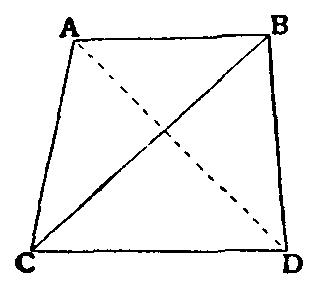 Fig. 57.
31. Braced Girders.?A frame is a rigid structure composed of straight struts and ties. The struts and ties are called bracing bars. The frame as a whole may be subject to a bending moment, but each member is simply extended or compressed so that the total stress on a given member is the same at all its cross sections, while the intensity of stress is uniform for all the parts of any one cross section. This result must follow in any frame, the members of which are so connected that the joints offer little or no resistance to
