by Various
Available in 585 free installments
Owner:
Let a frame (without redundant members), and the external forces which keep it in equilibrium, be represented by a diagram constituting one of these two plane figures, then the lines in the other plane figure or the reciprocal will represent in direction and magnitude the forces between the joints of the frame, and, consequently, the stress on each member, as will now be explained.
Reciprocal figures are easily drawn by following definite rules, and afford therefore a simple method of computing the stresses on members of a frame.
The external forces on a frame or bridge in equilibrium under those forces may, by a well-known proposition in statics, be represented by a closed polygon, each side of which is parallel to one force, and represents the force in magnitude as well as in direction. The sides of the polygon may be arranged in any order, provided care is taken so to draw them that in passing round the polygon in one direction this direction may for each side correspond to the direction of the force which it represents.
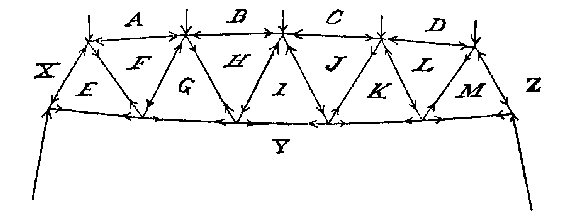 Fig. 66.
This polygon of forces may, by a slight extension of the above definition, be called the reciprocal figure of the external forces, if the sides are arranged in the same order as that of the joints on which they act, so that if the joints and forces be numbered 1, 2, 3, 4, &c., passing round the outside of the frame in one direction, and returning at last to joint 1, then in the polygon the side representing the force 2 will be next the side representing the force 1, and will be followed by the side representing the force 3, and so forth. This polygon falls under the definition of a reciprocal figure given by Clerk Maxwell, if we consider the frame as a point in equilibrium under the external forces.
Fig. 66 shows a frame supported at the two end joints, and loaded at each top joint. The loads and the supporting forces are indicated by arrows. Fig. 67a shows the reciprocal figure or polygon for the external forces on the assumption that the reactions are slightly inclined. The lines in fig. 67 a, lettered in the usual manner, correspond to the forces indicated by arrows in fig. 66, and lettered according to Bow's method. When all the forces are vertical, as will be the case in girders, the polygon of external forces will be reduced to two straight lines, fig. 67 b, superimposed and divided so that the length AX represents the load AX, the length AB the load AB, the length YX the reaction YX, and so forth. The line XZ consists of a series of lengths, as XA, AB ... DZ, representing the loads taken in their order. In subsequent diagrams the two reaction lines will, for the sake of clearness, be drawn as if slightly inclined to the vertical.
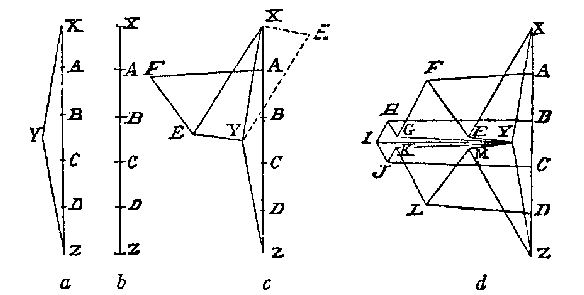 Fig. 67.
If there are no redundant members in the frame there will be only two members abutting at the point of support, for these two members will be sufficient to balance the reaction, whatever its direction may be; we can therefore draw two triangles, each having as one side the reaction YX, and having the two other sides parallel to these two members; each of these triangles will represent a polygon of forces in equilibrium at the point of support. Of these two triangles, shown in fig. 67 c, select that in which the letters X and Y are so placed that (naming the apex of the triangle E) the lines XE and YE are the lines parallel to the two members of the same name in the frame (fig. 66). Then the triangle YXE is the reciprocal figure of the three lines YX, XE, EY in the frame, and represents the three forces in equilibrium at the point YXE of the frame. The direction of YX, being a thrust upwards, shows the direction in which we must go round the triangle YXE to find the direction of the two other forces; doing this we find that the force XE must act down towards the point YXE, and the force EY away from the same point. Putting arrows on the frame diagram to indicate the direction of the forces, we see that the member EY must pull and therefore act as a tie, and that the member XE must push and act as a strut. Passing to the point XEFA we find two known forces, the load XA acting downwards, and a push from the strut XE, which, being in compression, must push at both ends, as indicated by the arrow, fig. 66. The
