directions and magnitudes of these two forces are already drawn (fig. 67
a) in a fitting position to represent part of the polygon of forces at XEFA; beginning with the upward thrust EX, continuing down XA, and drawing AF parallel to AF in the frame we complete the polygon by drawing EF parallel to EF in the frame. The point F is determined by the intersection of the two lines, one beginning at A, and the other at E. We then have the polygon of forces EXAF, the reciprocal figure of the lines meeting at that point in the frame, and representing the forces at the point EXAF; the direction of the forces on EH and XA being known determines the direction of the forces due to the elastic reaction of the members AF and EF, showing AF to push as a strut, while EF is a tie. We have been guided in the selection of the particular quadrilateral adopted by the rule of arranging the order of the sides so that the same letters indicate corresponding sides in the diagram of the frame and its reciprocal. Continuing the construction of the diagram in the same way, we arrive at fig. 67
d as the complete reciprocal figure of the frame and forces upon it, and we see that each line in the reciprocal figure measures the stress on the corresponding member in the frame, and that the polygon of forces acting at any point, as IJKY, in the frame is represented by a polygon of the same name in the reciprocal
figure. The direction of the force in each member is easily ascertained by proceeding in the manner above described. A single known force in a polygon determines the direction of all the others, as these must all correspond with arrows pointing the same way round the polygon. Let the arrows be placed on the frame round each joint, and so as to indicate the direction of each force on that joint; then when two arrows point to one another on the same piece, that piece is a tie; when they point from one another the piece is a strut. It is hardly necessary to say that the forces exerted by the two ends of any one member must be equal and opposite. This method is universally applicable where there are no redundant members. The reciprocal figure for any loaded frame is a complete formula for the stress on every member of a frame of that particular class with loads on given joints.
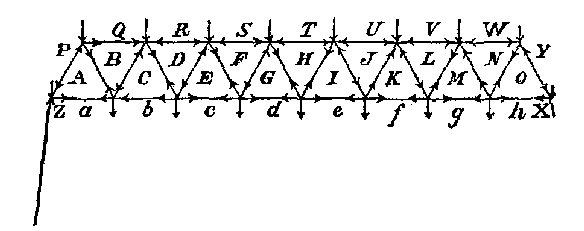 Fig.
Fig. 68
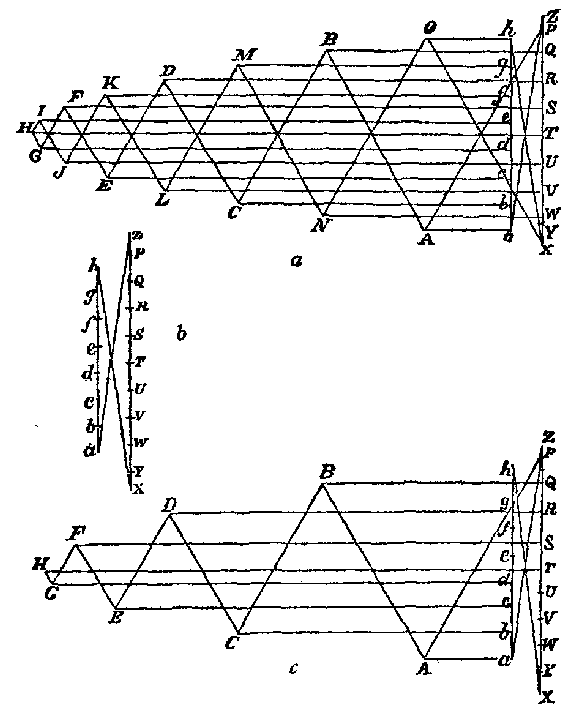 Fig.
Fig. 69
Consider a Warren girder (fig. 68), loaded at the top and bottom joints. Fig. 69 b is the polygon of external forces, and 69 c is half the reciprocal figure. The complete reciprocal figure is shown in fig. 69 a.
The method of sections already described is often more convenient than the method of reciprocal figures, and the method of influence lines is also often the readiest way of dealing with braced girders.
35. Chain Loaded uniformly along a Horizontal Line.?If the lengths of the links be assumed indefinitely short, the chain under given simple distributions of load will take the form of comparatively simple mathematical curves known as catenaries. The true catenary is that assumed by a chain of uniform weight per unit of length, but the form generally adopted for suspension bridges is that assumed by a chain under a weight uniformly distributed relatively to a horizontal line. This curve is a parabola.
Remembering that in this case the centre bending moment ?wl will be equal to wL²/8, we see that the horizontal tension H at the vertex for a span L (the points of support being at equal heights) is given by the expression
1 . . . H = wL²/8y,
or, calling x the distance from the vertex to the point of support,
H = wx²/2y,
The value of H is equal to the maximum tension on the bottom flange, or compression on the top flange, of a girder of equal span, equally and similarly loaded, and having a depth equal to the dip of the suspension bridge.
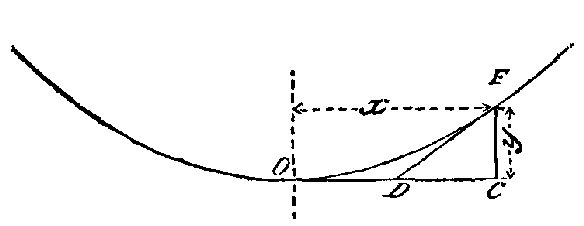 Fig.
Fig. 70.
Consider any other point F of the curve, fig. 70, at a distance x from the vertex, the horizontal
