by Various
Available in 585 free installments
Owner:
H : V = DC : FC = wx²/2y : wx = x/2 : y,
hence DC is the half of OC, proving the curve to be a parabola.
The value of R, the tension at any point at a distance x from the vertex, is obtained from the equation
R² = H²+V² = w²x4/4y²+w²x²,
or,
2 . . . R = wx?(1+x²/4y²).
Let i be the angle between the tangent at any point having the co-ordinates x and y measured from the vertex, then
3 . . . tan i = 2y/x.
Let the length of half the parabolic chain be called s, then
4 . . . s = x+2y²/3x.
The following is the approximate expression for the relation between a change ?s in the length of the half chain and the corresponding change ?y in the dip:?
s+?s = x+(2/3x) {y²+2y?y+(?y)²} = x+2y²/3x+4y?y/3x+2?y²/3x,
or, neglecting the last term,
5 . . . ?s = 4y?y/3x,
and
6 . . . ?y = 3x?s/4y.
From these equations the deflection produced by any given stress on the chains or by a change of temperature can be calculated.
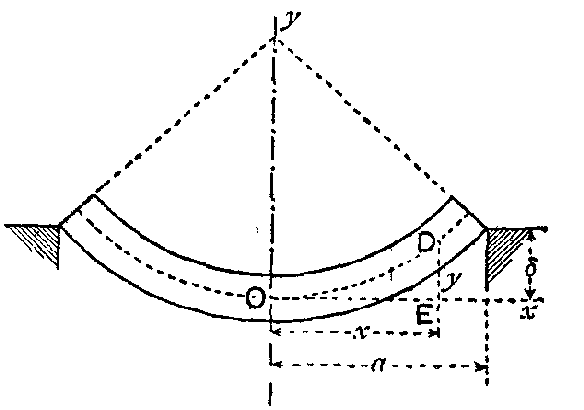 Fig. 71.
36. Deflection of Girders.? Let fig. 71 represent a beam bent by external loads. Let the origin O be taken at the lowest point of the bent beam. Then the deviation y = DE of the neutral axis of the bent beam at any point D from the axis OX is given by the relation
d²y dx² |
= | M EI |
where M is the bending moment and I the amount of inertia of the beam at D, and E is the coefficient of elasticity. It is usually accurate enough in deflection calculations to take for I the moment of inertia at the centre of the beam and to consider it constant for the length of the beam. Then
| dy dx |
= | 1 EI |
?Mdx |
| y = | 1 EI |
??Mdx². |
The integration can be performed when M is expressed in terms of x. Thus for a beam supported at the ends and loaded with w per inch length M = w(a²-x²), where a is the half span. Then the deflection at the centre is the value of y for x = a, and is
| ? = | 5 24 |
wa4 EI |
. |
The radius of curvature of the beam at D is given by the relation
R = EI/M.