by Various
Available in 585 free installments
Owner:
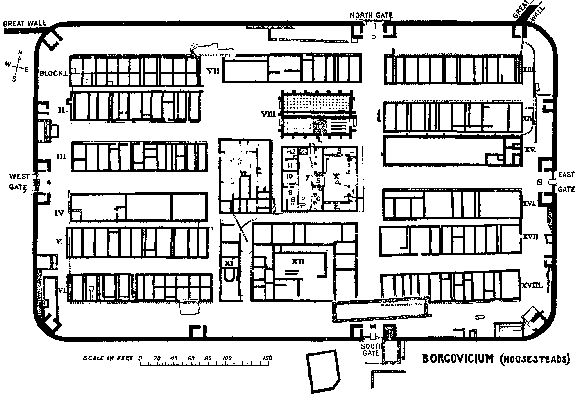 Fig. 1.?Plan of Housesteads (Borcovicium) on Hadrian's Wall.
The army which guarded or coerced the province consisted, from the time of Hadrian onwards, of (1) three legions, the Second at Isca Silurum (Caerleon-on-Usk, q.v.), the Ninth at Ebur?cum (q.v.; now York), the Twentieth at Deva (q.v.; now Chester), a total of some 15,000 heavy infantry; and (2) a large but uncertain number of auxiliaries, troops of the second grade, organized in infantry cohorts or cavalry alae, each 500 or 1000 strong, and posted in castella nearer the frontiers than the legions. The legionary fortresses were large rectangular enclosures of 50 or 60 acres, surrounded by strong walls of which traces can still be seen in the lower courses of the north and east town-walls of Chester, in the abbey gardens at York, and on the south side of Caerleon. The auxiliary castella were hardly a tenth of the size, varying generally from three to six acres according to the size of the regiment and the need for stabling. Of these upwards of 70 are known in England and some 20 more in Scotland. Of the English examples a few have been carefully excavated, notably Gellygaer between Cardiff and Brecon, one of the most perfect specimens to be found anywhere in the Roman empire of a Roman fort dating from the end of the 1st century A.D.; Hardknott, on a Cumberland moor overhanging Upper Eskdale; and Housesteads on Hadrian's wall. In Scotland excavation has been more active, in particular at the forts of Birrens, Newstead near Melrose, Lyne near Peebles, Ardoch between Stirling and Perth, and Castle Cary, Rough Castle and Bar Hill on the wall of Pius. The internal arrangements of all these forts follow one general plan. But in some of them the internal buildings are all of stone, while in others, principally (it seems) forts built before 150, wood is used freely and only the few principal buildings seem to have been constructed throughout of stone.
We may illustrate their character from Housesteads, which, in the form in which we know it, perhaps dates from Septimius Severus. This fort measures about 360 by 600 ft. and covers a trifle less than 5 acres. Its ramparts are of stone, and its north rampart coincides with the great wall of Hadrian. Its interior is filled with stone buildings. Chief among these (see fig. 1), and in the centre of the whole fort, is the Headquarters, in Lat. Principia or, as it is often (though perhaps less correctly) styled by moderns, Praetorium. This is a rectangular structure with only one entrance which gives access, first, to a small cloistered court (x. 4), then to a second open court (x. 7), and finally to a row of five rooms (x. 8-12) containing the shrine for official worship, the treasury and other offices. Close by were officers' quarters, generally
