by Various
Available in 585 free installments
Owner:
Forts of this kind were dotted all along the military roads of the Welsh and northern hill-districts. In Wales a road ran from Chester past a fort at Caer-hyn (near Conway) to a fort at Carnarvon (Segontium). A similar road ran along the south coast from Caerleon-on-Usk past a fort at Cardiff and perhaps others, to Carmarthen. A third, roughly parallel to the shore of Cardigan Bay, with forts at Llanio and Tommen-y-mur (near Festiniog), connected the northern and southern roads, while the interior was held by a system of roads and forts not yet well understood but discernible at such points as Caer-gai on Bala Lake, Castle Collen near Llandrindod Wells, the Gaer near Brecon, Merthyr and Gellygaer. In the north of Britain we find three principal roads. One led due north from York past forts at Catterick Bridge, Piers Bridge, Binchester, Lanchester, Ebchester to the wall and to Scotland, while branches through Chester-le-Street reached the Tyne Bridge (Pons Aelius) at Newcastle and the Tyne mouth at South Shields. A second road, turning north-west from Catterick Bridge, mounted the Pennine Chain by way of forts at Rokeby, Bowes and Brough-under-Stainmoor, descended into the Eden valley, reached Hadrian's wall near Carlisle (Luguvallium), and passed on to Birrens. The third route, starting from Chester and passing up the western coast, is more complex, and exists in duplicate, the result perhaps of two different schemes of road-making. Forts in plenty can be detected along it, notably Manchester (Mancunium or Mamucium), Ribchester (Bremetennacum), Brougham Castle (Brocavum), Old Penrith (Voreda), and on a western branch, Watercrook near Kendal, Waterhead near the hotel of that name on Ambleside, Hardknott above Eskdale, Maryport (Uxellod?num), and Old Carlisle (possibly Petriana). In addition, two or three cross roads, not yet sufficiently explored, maintained communication between the troops in Yorkshire and those in Cheshire and Lancashire. This road system bears plain marks of having been made at different times, and with different objectives, but we have no evidence that any one part was abandoned when any other was built. There are signs, however, that various forts were dismantled as the country grew quieter. Thus, Gellygaer in South Wales and Hardknott in Cumberland have yielded nothing later than the opening of the 2nd century.
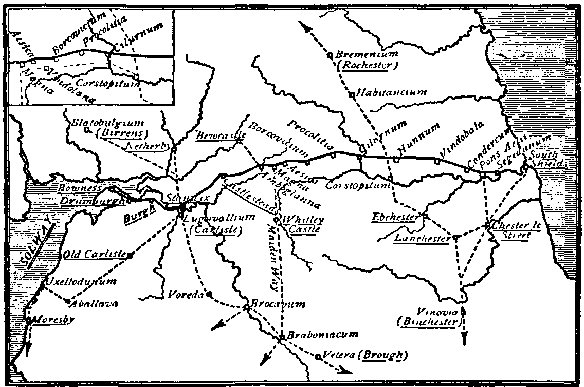 Fig. 2.?Hadrian's Wall.
From Social England, by permission of Cassell & Co., Ltd.
Besides these detached forts and their connecting roads, the north of Britain was defended by Hadrian's wall (figs. 2 and 3). The history of this wall has been given above. The actual works are threefold. First, there is that which to-day forms the most striking feature in the whole, the wall of stone 6-8 ft. thick, and originally perhaps 14 ft. high, with a deep ditch in front, and forts and "mile castles" and turrets and a connecting road behind it. On the high moors between Chollerford and Gilsland its traces are still plain, as it climbs from hill to hill and winds along perilous precipices. Secondly, there is the so-called "Vallum," in reality no vallum at all, but a broad flat-bottomed ditch out of which the earth has been cast up on either side into regular and continuous mounds that resemble ramparts. Thirdly, nowhere very clear on the surface and as yet detected only at a few points, there are the remains of the "turf wall," constructed of sods laid in regular courses, with a ditch in front. This turf wall is certainly older than the stone wall, and, as our ancient writers mention two wall-builders, Hadrian and Septimius Severus, the natural inference is that Hadrian built his wall of turf and Severus reconstructed it in stone. The reconstruction probably followed in general the line of Hadrian's wall in order to utilize the existing ditch, and this explains why the turf wall itself survives only at special points. In general it was destroyed to make way for
