by Various
Available in 585 free installments
Owner:
Grinding.?In most modern breweries the malt passes, on its way from the bins to the mill, through a cleaning and grading apparatus, and then through an automatic measuring machine. The mills, which exist in a variety of designs, are of the smooth roller type, and are so arranged that the malt is crushed rather than ground. If the malt is ground too fine, difficulties arise in regard to efficient drainage in the mash-tun and subsequent clarification. On the other hand, if the crushing is too coarse the subsequent extraction of soluble matter in the mash-tun is incomplete, and an inadequate yield results.
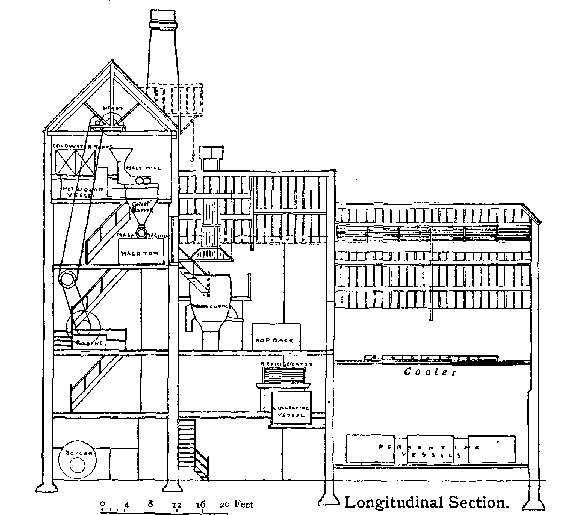 Fig. 1.?An 8-quarter Brewery (Messrs. L. Lumley & Co., Ltd.).
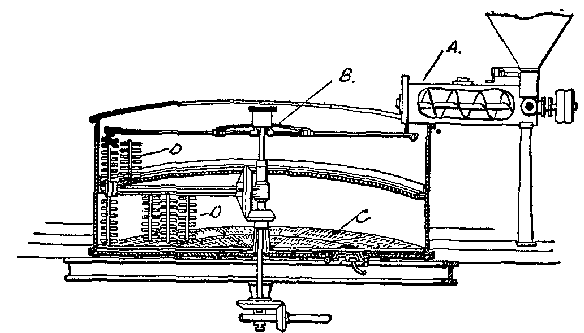 Fig. 2.?Mash-tun with mashing machine.
Mashing is a process which consists mainly in extracting, by means of water at an adequate temperature, the soluble matters pre-existent in the malt, and in converting the insoluble starch and a great part of the insoluble nitrogenous compounds into soluble and partly fermentable products. Mashing is, without a doubt, the most important of the brewing processes, for it is largely in the mash-tun that the character of the beer to be brewed is determined. In modern practice the malt and the mashing "liquor" (i.e. water) are introduced into the mash-tun simultaneously, by means of the mashing machine (fig. 2, A). This is generally a cylindrical metal vessel, commanding the mash-tun and provided with a central shaft and screw. The grist (as the crushed malt is called) enters the mashing machine from the grist case above, and the liquor is introduced at the back. The screw is rotated rapidly, and so a thorough mixture of the grist and liquor takes place as they travel along the mashing machine. The mash-tun (fig. 2) is a large metal or wooden vessel, fitted with a false bottom composed of plates perforated with numerous small holes or slits (C). This arrangement is necessary in order to obtain a proper separation of the "wort" (as the liquid portion of the finished mash is called) from the spent grains. The mash-tun is also provided with a stirring apparatus (the rakes) so that the grist and liquor may be intimately mixed (D), and an automatic sprinkler, the sparger (fig. 2, B, and fig. 3), which is employed in order to wash out the wort remaining in the grains. The sparger consists of a number of hollow arms radiating from a common centre and pierced by a number of small perforations. The common central vessel from which the sparge-arms radiate is mounted in such a manner that it rotates automatically when a stream of water is admitted, so that a constant fine spray covers the whole tun when the sparger is in operation. There are also pipes for admitting "liquor" to the bottom of the tun, and for carrying the wort from the latter to the "underback" or "copper."
The grist and liquor having been introduced into the tun (either by means of the mashing machine or separately), the rakes are set going, so that the mash may become thoroughly homogeneous, and after a short time the rakes are stopped and the mash allowed to rest, usually for a period of about two hours. After this, "taps are set"?i.e. communication is established between the mash-tun and the vessel into which the wort runs?and the sparger is started. In this manner the whole of the wort or extract is separated from the grains. The quantity of water employed is, in all, from two to three barrels to the quarter (336 lb) of malt.
