by Various
Available in 585 free installments
Owner:
In considering the process of mashing, one might almost say the process of brewing, it is essential to remember that the type and quality of the beer to be produced (see Malt) depends almost entirely (a) on the kind of malt employed, and (b) on the mashing temperature. In other words, quality may be controlled on the kiln or in the mash-tun, or both. Viewed in this light, the following theoretical methods for preparing different types of beer are possible:?(1) high kiln heats and high mashing temperatures; (2) high kiln heats and low mashing temperatures; (3) low kiln heats and high mashing temperatures; and (4) low kiln heats and low mashing temperatures. In practice all these combinations, together with many intermediate ones, are met with, and it is not too much to say that the whole science of modern brewing is based upon them. It is plain, then, that the mashing temperature will depend on the kind of beer that is to be produced, and on the kind of malt employed. For stouts and black beers generally, a mashing temperature of 148° to 150° F. is most usual; for pale or stock ales, 150° to 154° F.; and for mild running beers, 154° to 149° F. The range of temperatures employed in brewing English beers is a very limited one as compared with foreign mashing methods, and does not range further, practically speaking, than from 140° to 160° F. The effect of higher temperatures is chiefly to cripple the enzyme or "ferment" diastase, which, as already said, is the agent which converts the insoluble starch into soluble dextrin, sugar and intermediate products. The higher the mashing temperature, the more the diastase will be crippled in its action, and the more dextrinous (non-fermentable) matter as compared with maltose (fermentable sugar) will be formed. A pale or stock ale, which is a type of beer that must be "dry" and that will keep, requires to contain a relatively high proportion of dextrin and little maltose, and, in its preparation, therefore, a high mashing temperature will be employed. On the other hand, a mild running ale, which is a full, sweet beer, intended for rapid consumption, will be obtained by means of low mashing temperatures, which produce relatively little dextrin, but a good deal of maltose, i.e. sweet and readily fermentable matter.
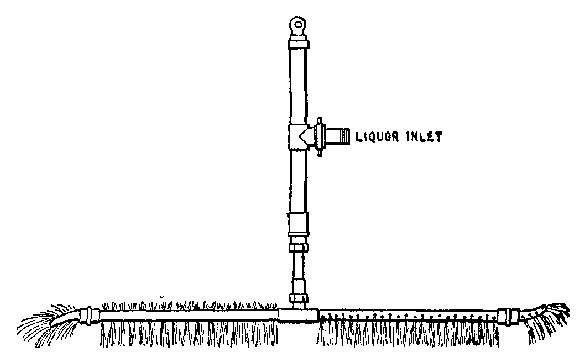 Fig. 3.?Sparger.
Diastase is not the only enzyme present in malt. There is also a ferment which renders a part of the nitrogenous matter soluble. This again is affected by temperature in much the same way as diastase. Low heats tend to produce much non-coagulable nitrogenous matter, which is undesirable in a stock beer, as it tends to produce fret and side fermentations. With regard to the kind of malt and other materials employed in producing various types of beer, pale ales are made either from pale malt (generally a mixture of English and fine foreign, such as Smyrna, California) only, or from pale malt and a little flaked maize, rice, invert sugar or glucose. Running beers (mild ale) are made from a mixture of pale and amber malts, sugar and flaked goods; stout, from a mixture of pale, amber and roasted (black) malts only, or with the addition of a little sugar or flaked maize.
When raw grain is employed, the process of mashing is slightly modified. The maize, rice or other grain is usually gelatinized in a vessel (called a converter or cooker) entirely separated from the mash-tun, by means of steam at a relatively high temperature, mostly with, but occasionally without, the addition of some malt meal. After about half an hour the gelatinized mass is mixed with the main mash, and this takes place shortly before taps are set. This is possible inasmuch as the starch, being already in a highly disintegrated condition, is very rapidly converted. By working on the limited-decoction system (see below), it is possible to make use of a fair percentage of raw grain in the mash-tun proper, thus doing away with the "converter" entirely.
