by Various
Available in 585 free installments
Owner:
Grout is thin liquid mortar, and is legitimately used in gauged arches and other work when fine joints are desired. In ordinary work it is sometimes used every four or five courses to fill up any spaces that may have been inadvertently left between the bricks. This at the best is but doing with grout what should be done with mortar in the operation of laying the bricks; and filling or flushing up every course with mortar requires but little additional exertion and is far preferable. The use of grout is, therefore, a sign of inefficient workmanship, and should not be countenanced in good work. It is liable, moreover, to ooze out and stain the face of the brickwork.
Lime putty is pure slaked lime. It is prepared or "run," as it is termed, in a wooden tub or bin, and should be made as long a time as possible before being used; at least three weeks should elapse between preparation and use.
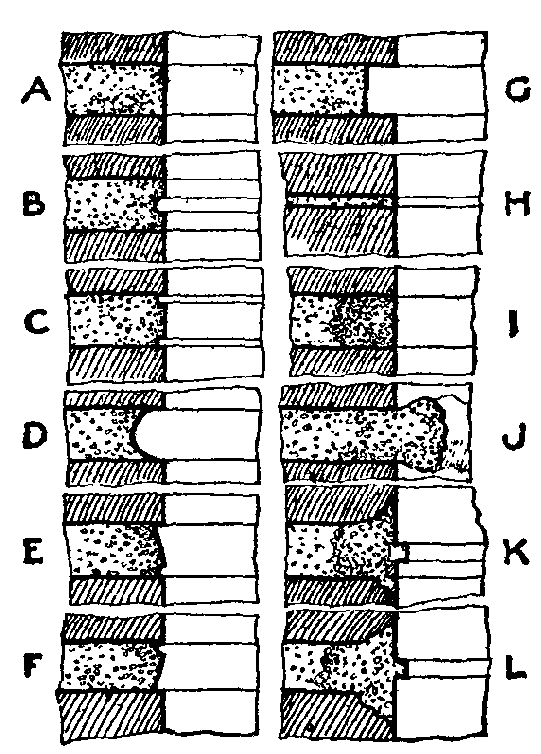 Fig. 3.?Forms of Joints.
The pointing of a wall, as previously mentioned, is done either with the bricklaying or at the completion of the work. If the Pointing. pointing is to be of the same mortar as the rest of the work, it would probably greatly facilitate matters to finish off the work at one operation with the bricklaying, but where, as in many cases, the pointing is required to be executed in a more durable mortar, this would be done as the scaffold is taken down at the completion of the building, the joints being raked out by the bricklayer to a depth of ½ or ¾ in. By the latter method the whole face of the work is kept uniform in appearance. The different forms of joints in general use are clearly shown in fig. 3. Flat or flush joints (A) are formed by pressing the protruding mortar back flush with the face of the brickwork. This joint is commonly used for walls intended to be coated with distemper or limewhite. The flat joint jointed (two forms, B and C) is a development of the flush joint. In order to increase the density and thereby enhance the durability of the mortar, a semicircular groove is formed along the centre, or one on each side of the joint, with an iron jointer and straight-edge. Another form, rarely used, is the keyed joint shown at D, the whole width of the joint in this case being treated with the curved key. Struck or bevelled, or weathered, joints have the upper portion pressed back with the trowel to form a sloping surface, which throws off the wet. The lower edge is cut off with the trowel to a straight edge. This joint is in very common use for new work. Ignorant workmen frequently make the slope in the opposite direction (F), thus forming a ledge on the brick; this catches the water, which on being frozen rapidly causes the disintegration of the upper portion of the brick and of the joint itself. With recessed jointing, not much used, a deep shadow may be obtained. This form of joint, illustrated in G, is open to very serious objections, for it encourages the soaking of the brick with rain instead of throwing off the wet, as it seems the natural function of good pointing, and this, besides causing undue dampness in the wall, renders it liable to damage by frost. It also leaves the arrises of the bricks unprotected and liable to be damaged, and from its deep recessed form does not make for stability in the work. Gauged work has very thin joints, as shown at H, formed by dipping the side of the brick in white lime putty. The sketch I shows a joint raked out and filled in with pointing mortar to form a flush joint, or it may be finished in any of the preceding forms. Where the wall is to be plastered the joints are either left open or raked out, or the superfluous mortar may be left protruding as shown at J. By either method an excellent key is obtained, to which the rendering firmly adheres. In tuck pointing (K) the joints are raked out and stopped, i.e. filled in flush with mortar coloured to match the brickwork. The face of the wall is then rubbed over with a
