by Various
Available in 585 free installments
Owner:
Footings, as will be seen on reference to fig. 1, are the wide courses of brickwork at the base or foot of a wall. They serve to spread Footings. the pressure over a larger area of ground, offsets 2¼ in. wide being made on each side of the wall until a width equal to double the thickness of the wall is reached. Thus in a wall 13½ in. (1½ bricks) thick, this bottom course would be 2 ft. 3 in. (3 bricks) wide. It is preferable for greater strength to double the lowest course. The foundation bed of concrete then spreading out an additional 6 in. on each side brings the width of the surface bearing on the ground to 3 ft. 3 in. The London Building Act requires the projection of concrete on each side of the brickwork to be only 4 in., but a projection of 6 in. is generally made to allow for easy working. Footings should be built with hard bricks laid principally as headers; stretchers, if necessary, should be placed in the middle of the wall.
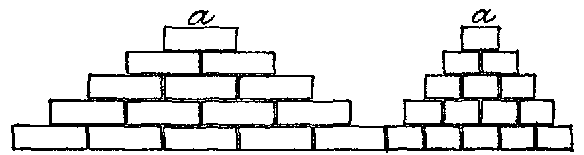 Fig. 4.?Diagram of Bonding.
Bond in brickwork is the arrangement by which the bricks of every course cover the joints of those in the course below it, and so Bonding. tend to make the whole mass or combination of bricks act as much together, or as dependently one upon another, as possible. The workmen should be strictly supervised as they proceed with the work, for many failures are due to their ignorance or carelessness in this particular. The object of bonding will be understood by reference to fig. 4. Here it is evident from the arrangement of the bricks that any weight placed on the topmost brick (a) is carried down and borne alike in every course; in this way the weight on each brick is distributed over an area increasing with every course. But this forms a longitudinal bond only, which cannot extend its influence beyond the width of the brick; and a wall of one brick and a half, or two bricks, thick, built in this manner, would in effect consist of three or four half brick thick walls acting independently of each other. If the bricks were turned so as to show their short sides or ends in front instead of their long ones, certainly a compact wall of a whole brick thick, instead of half a brick, would be produced, and while the thickness of the wall would be double, the longitudinal bond would be shortened by one-half: a wall of any great thickness built in this manner would necessarily be composed of so many independent one-brick walls. To produce a transverse and yet preserve a true longitudinal bond, the bricks are laid in a definite arrangement of stretchers and headers.
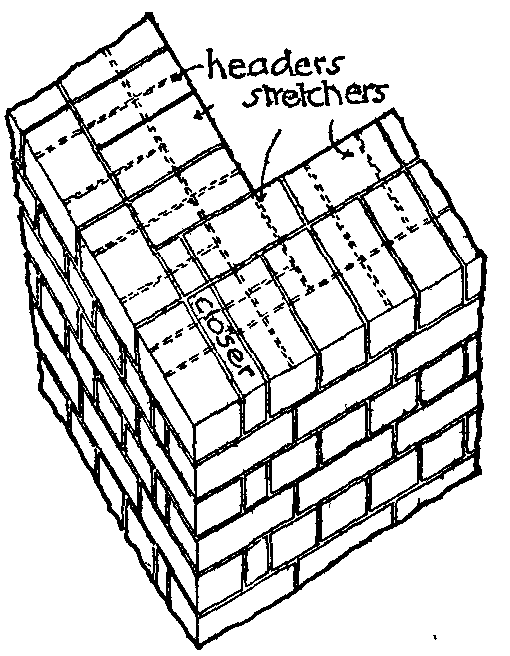 Fig. 5.?English Bond.
In this and following illustration of bond in brickwork the position of bricks in the second course is indicated by dotted lines.
In "English bond" (fig. 5), rightly considered the most perfect in use, the bricks are laid in alternate courses of headers and stretchers, thus combining the advantages of the two previous modes of arrangement. A reference to fig. 5 will show how the process of bonding is pursued in a wall one and a half bricks in thickness, and how the quoins are formed. In walls which are a multiple of a whole brick, the appearance of the same course is similar on the elevations of the front and back faces, but in walls where an odd half brick must be used to make up the thickness, as is the case in the illustration, the appearance of the opposite sides of a course is inverted. The example illustrates the principle of English bond; thicker walls are constructed in the same manner by an extension of the same methods. It will be observed that portions of a brick have to be inserted near a vertical end or a quoin, in order to start the regular bond. These portions equal a half header in width, and are called queen closers; they are placed next to the first header. A three-quarter brick is obviously as
