by Various
Available in 585 free installments
Owner:
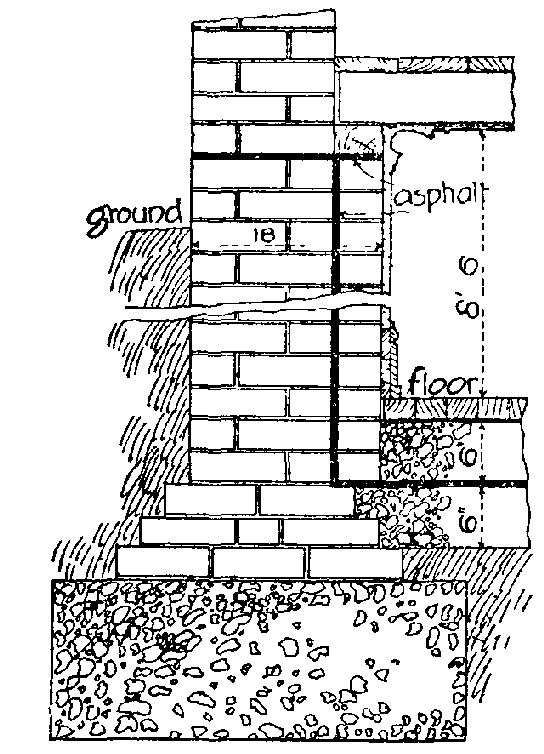 Fig. 10.
Moisture is prevented from soaking down from the top of the wall by using a covering of some impervious material in the form of a coping. This may consist of ordinary bricks set on edge in cement with a double course of tiles immediately below, called a "creasing," or of specially made non-porous coping bricks, or of stone, cast-iron, or cement sloped or "weathered" in order to throw the rain off.
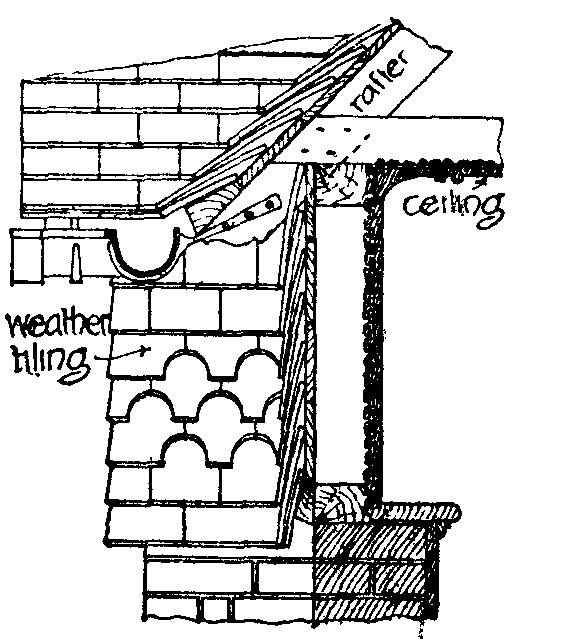 Fig. 13.
The exterior of walls above the ground line may be protected by coating the surface with cement or rough cast; or covering with slates or tiles fixed on battens in a similar manner to those on a roof (fig.13).
The use of hollow walls in exposed positions has already been referred to.
The by-laws dated 1891, made by the London County Council under section 16 of the Metropolis Management and Buildings Acts Amendment Act 1878, require that "every wall of a house or building shall have a damp course composed of materials impervious to moisture approved by the district surveyor, extending throughout its whole thickness at the level of not less than 6 in. below the level of the lowest floor. Every external wall or enclosing wall of habitable rooms or their appurtenances or cellars which abuts against the earth shall be protected by materials impervious to moisture to the satisfaction of the district surveyor..." "The top of every party-wall and parapet-wall shall be finished with one course of hard, well-burnt bricks set on edge, in cement, or by a coping of any other waterproof and fire-resisting material, properly secured."
Arches are constructions built of wedge-shaped blocks, which by reason of their shape give support one to another, and to the Arches. super-imposed weight, the resulting load being transmitted through the blocks to the abutments upon which the ends of the arch rest. An arch should be composed of such materials and designed of such dimensions as to enable it to retain its proper shape and resist the crushing strain imposed upon it. The abutments also must be strong enough to take safely the thrust of the weighted arch, as the slightest movement in these supports will cause deflection and failure. The outward thrust of an arch decreases as it approaches the semicircular form, but the somewhat prevalent idea that in the latter form no thrusting takes place is at variance with fact.
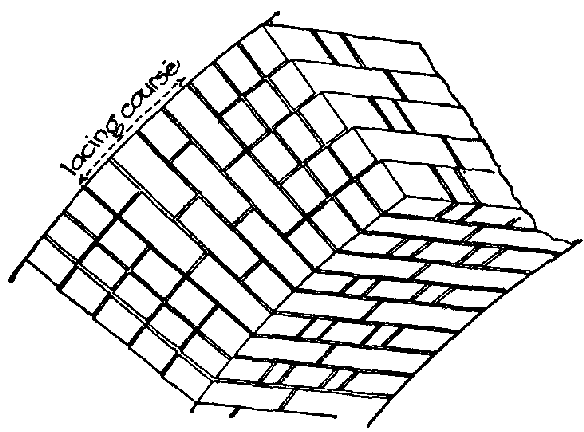 Fig. 14.
Arches in brickwork may be classed under three heads: plain arches, rough-cut and gauged. Plain arches are built of uncut bricks, and since the difference between the outer and inner periphery of the arch requires the parts of which an arch is made up to be wedge-formed, which an ordinary brick is not, the difference must be made in mortar, with the result that the joints become wedge-shaped. This obviously gives an objectionable inconsistency of material in the arch, and for this reason to obtain greatest strength it is advisable to build these arches in independent rings of half-brick thickness. The undermost rings should have thin joints, those of each succeeding ring being slightly thickened. This prevents the lowest ring from settling while those above remain in position, which would cause an ugly fissure. In work of large span bonding blocks or "lacing courses" should be built into the arch, set in cement and running through its thickness at intervals, care being taken to introduce the lacing course at a place where the joints of the various rings coincide. Stone blocks in the shape of a voussoir (fig. 14) may be used instead. Except for these lacing courses hydraulic lime mortar should be used for large arches, on account of its slightly accommodating nature.
Rough-cut arches are those in which the bricks are roughly cut with an axe to a wedge form; they are used over openings, such as doors and windows, where a strong arch of neat appearance is desired. The joints are usually made equal in width to those of the ordinary brickwork. Gauged arches are composed of specially made soft bricks, which
